
Introducing Budget Bubble Graphs

Here is a typical public debate about the budget deficit:

Republican:  Republicans are for smaller deficits.  You Democrats just want to increase spending.  Republicans want smaller deficits by cutting spending.

Democrat:  Hypocrite.  You Republicans increase deficits by cutting taxes without paying for them.  And you don’t really want to cut spending.  Democrats are for smaller deficits through a combination of responsible spending cuts and tax increases.

Republican:  When was the last time you enacted or even proposed a net spending cut?  Even when you do propose to cut spending, you just turn around and respend the money on some new government program.  You just want to raise taxes, then increase spending, leaving deficits exactly where they are.  Sometimes you don’t even bother with the tax increase, you just increase spending.  We are the party of lower deficits.

Democrat:  You mean, like you guys did with Medicare or you do with defense every year?  We are the party of lower deficits.

< one shoves the other and all hell breaks loose >

This kind of argument contributes more heat than light, in part because it focuses only on deficits and ignores a major philosophical distinction between the two parties:  different beliefs about the appropriate size of government.

I am going to do my best to illuminate this debate by expanding its scope and introducing a new kind of graph.  I call it a Budget Bubble Graph.

If this goes well we can use Budget Bubble Graphs to better understand the fiscal policy debate in Washington.  We can compare different budget proposals, analyze historic fiscal policy differences, and easily visualize the effects of various legislative proposals.  That’s a lot of responsibility for a little graph.  Today I’m going to introduce the graph format and begin to show how it can help you think about the above fiscal policy food fight.  I anticipate using Budget Bubble Graphs a lot in future posts.  Today’s post is therefore something of an investment for the future.

Introducing the Budget Bubble Graph

Bubble graphs are not new.  They are a standard graph type, a useful way to show three dimensions of data on a flat chart.  As far as I know, it is new to use them for the federal fiscal policy debate.

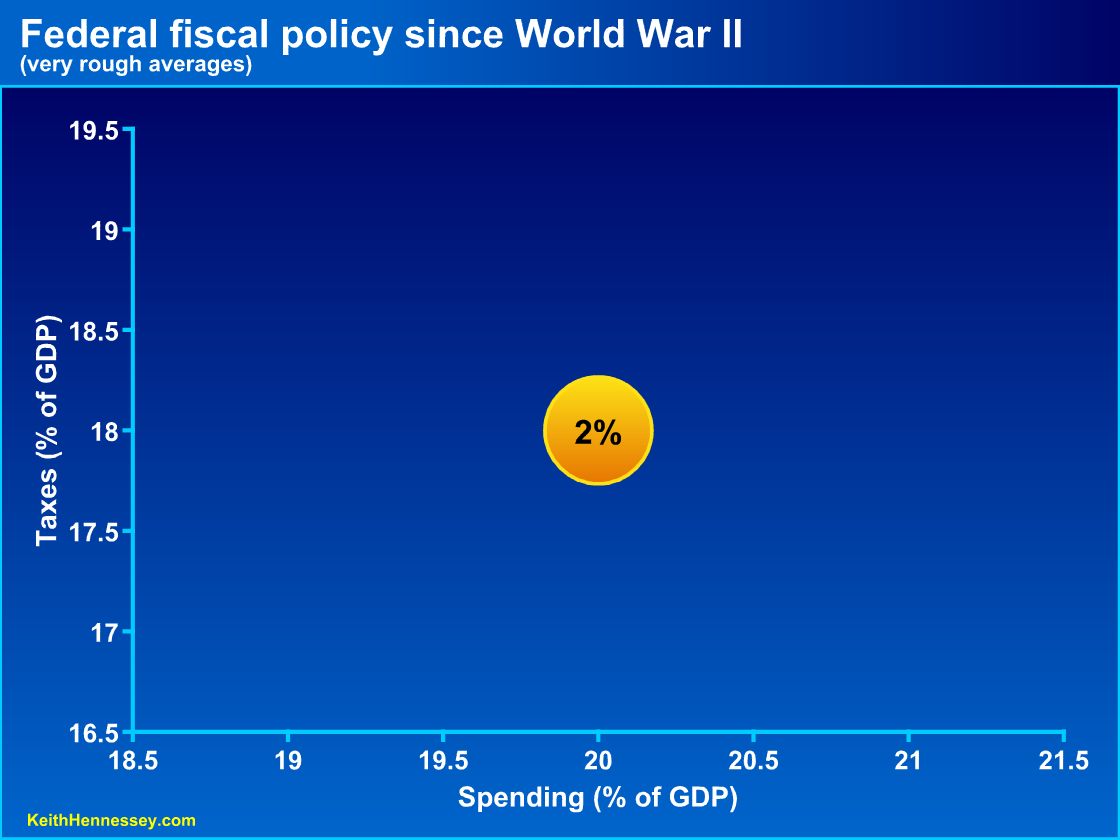
Let’s begin with the simplest possible graph.  Since the end of World War II the federal government has, on average, spent a little more than 20% of GDP.  Over the same time frame, it has financed this 20% by collecting a little more than 18% of GDP in taxes and borrowing the rest from future taxpayers, running an average deficit equal to about 2% of GDP.  I’m going to round the numbers to 20-18-2 to make it easy.  Frankly, the numbers matter little today.  We’re just trying to get used to the format.

In each case you can click on a graph to see a larger version.
bbg-00-intro-diagram

I want to point out a few subtle features about this fairly straightforward graph:

  • I have put spending on the x-axis because that is the primary fiscal policy choice made in Washington:  how much is the government going to spend?
  • The secondary fiscal policy choice is:  given how much we’re going to spend, how much of it are we going to tax now (y-axis) and how much are we going to borrow now (size of the bubble)?  Whatever we borrow now we will have to collect in future taxes.  Please think of deficits as equal to future taxes (with interest).
  • That’s a deficit bubble equal to 2% of GDP.  A bigger deficit would mean a bigger bubble.
  • The 2% deficit bubble size is the difference between the amount we’re spending (20% on the x-axis) and the amount we’re collecting in taxes (18% on the y-axis).
  • The bubble size is not to scale.  If it were it would be much bigger.  What matters for our purposes are the relative sizes of different bubbles.  I tried scaling it to size and the graph became too cluttered.

Graphing the simplest possible fiscal policy changes

Now let’s look at the simplest possible fiscal policy changes:

  • increasing spending by 1% of GDP;
  • cutting spending by 1% of GDP;
  • raising taxes by 1% of GDP; and
  • cutting taxes by 1% of GDP.

Please pay attention to the effect of each policy change on the deficit.
bbg-00b-intro-diagram-without-diagonals

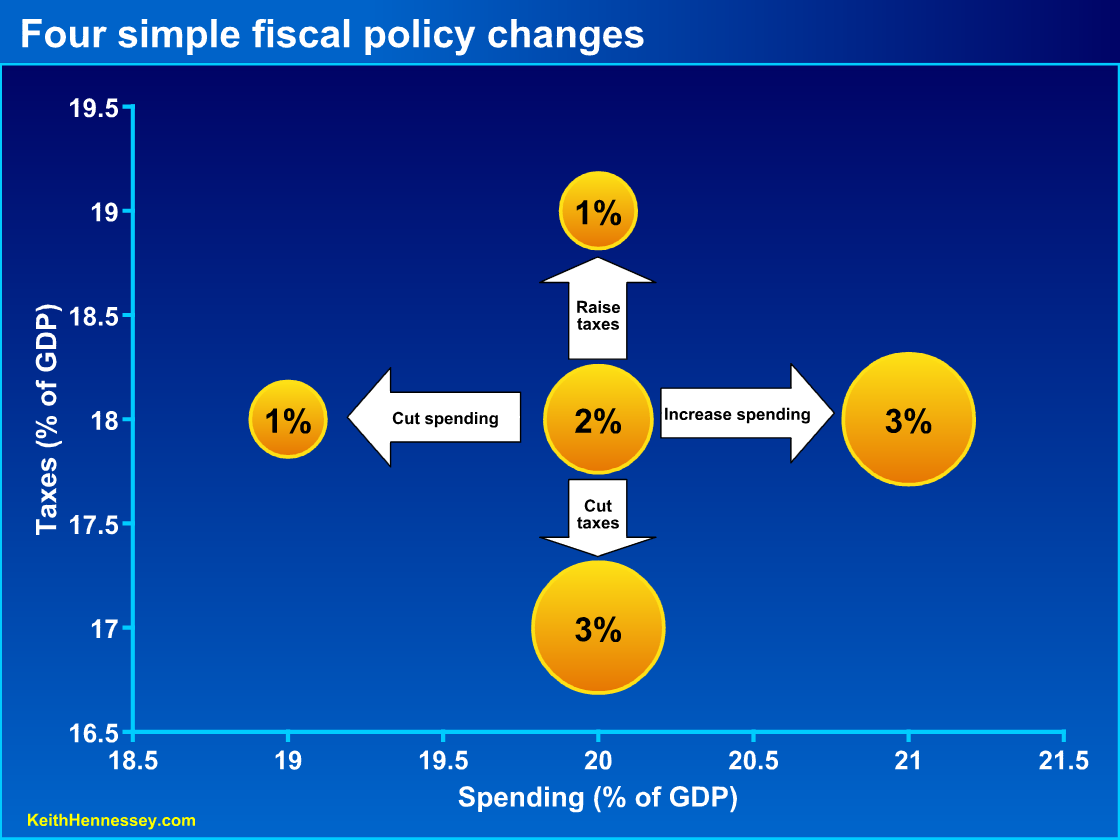
Starting from 3 o’clock on the graph, if we raise spending from 20% of GDP to 21%, we move right on the graph.  If we collect the same 18% of GDP in taxes (i.e., don’t move up or down), then we need to borrow 1% of GDP more, so our deficit bubble increases from 2% of GDP to 3% of GDP.  (The relative areas of the bubbles are properly scaled.)  Bigger bubble = bigger deficit = more borrowing now = higher future taxes.

Similarly, if we cut spending by 1% of GDP to 19% and hold taxes constant, we move left and reduce the budget deficit to the smaller 1% bubble at 9 o’clock on the graph.

You can see that if we change spending and hold taxes constant, the deficit changes to match the change in spending.  The 3 o’clock bubble represents a deficit-financed spending increase.  The 9 o’clock bubble represents a deficit-reducing spending cut.

Now let’s turn to taxes.  Starting with the 12 o’clock bubble, if we hold spending constant at 20% and raise taxes by 1% of GDP, from 18% to 19%, we move straight up and reduce the budget deficit from 2% to 1% of GDP.  This is a deficit-reducing tax increase.  I think of this policy change as shifting the burden of financing a given level of spending from future taxpayers to current taxpayers.  We get higher taxes now and lower taxes later.

Finally let’s look at the 6 o’clock bubble.  If we hold spending constant and cut taxes by 1% of GDP, we increase the budget deficit from 2% to 3% of GDP.  We are shifting the burden of financing a given level of spending from current taxpayers to future taxpayers.

Straightforward, no?  Please note that this graph format is designed to be value neutral.  It is simply an analytical tool.

We care about deficits and the size of government

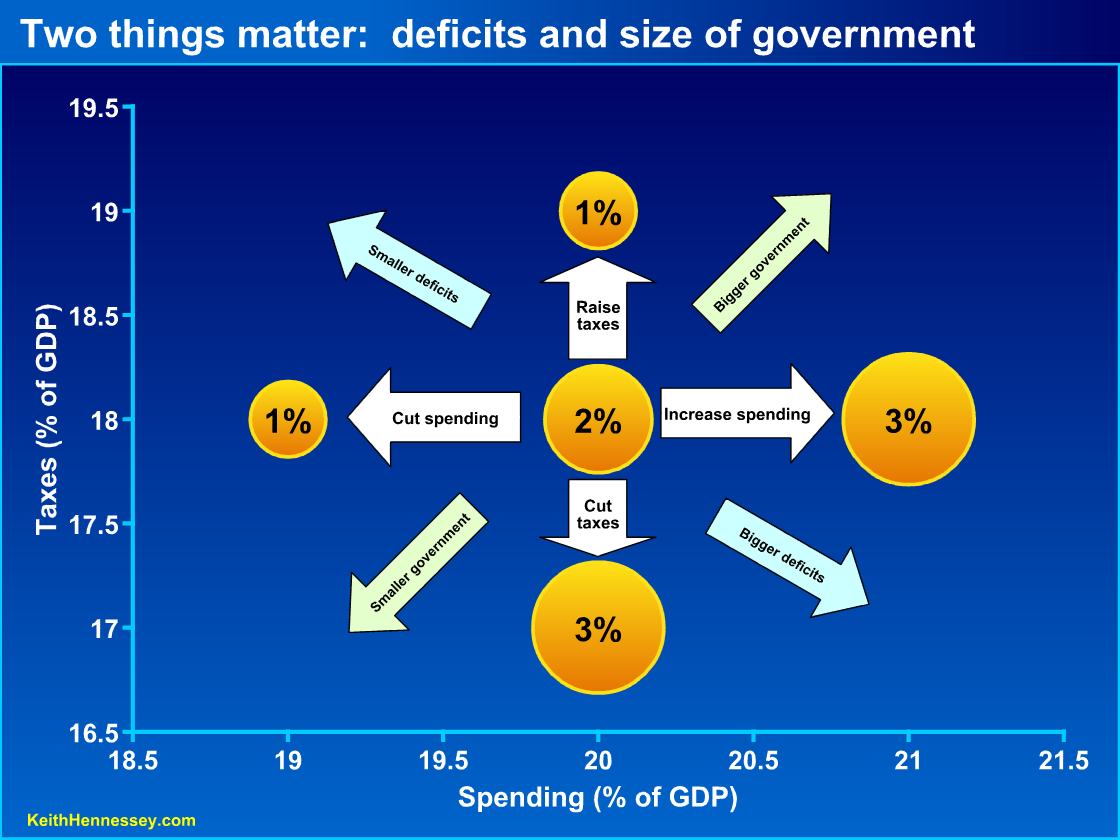
Let’s add one more layer of complexity.  I am going to add four diagonal arrows to the above graph.  Click the graph to see a bigger version.
bbg-00c-intro-diagram-with-diagonals

You can see that as we move up and/or to the left, deficits get smaller.  This makes sense – if we cut spending, raise taxes, or both, we get smaller budget deficits.

Deficits get bigger as we move down and/or to the right.  If we increase spending or cut taxes, we get bigger budget deficits.

Moving up and/or to the right represents bigger government, and moving down and/or to the left represents smaller government.  You could make the case that we should just look at spending to determine the size of government, but the policy debate suggests to me that diagonal arrows are more appropriate.

Now let’s use this tool to think about elements of the fiscal policy debate.

Our first strategic examples

Let’s use two graphs to look at the core philosophy driving the President’s and Congressional Democrats’ fiscal policy argument.  While the details of PAYGO are a little funky because they apply only to some types of federal spending, these two graphs represent the underlying concept.
bbg-00d-tax-and-spend

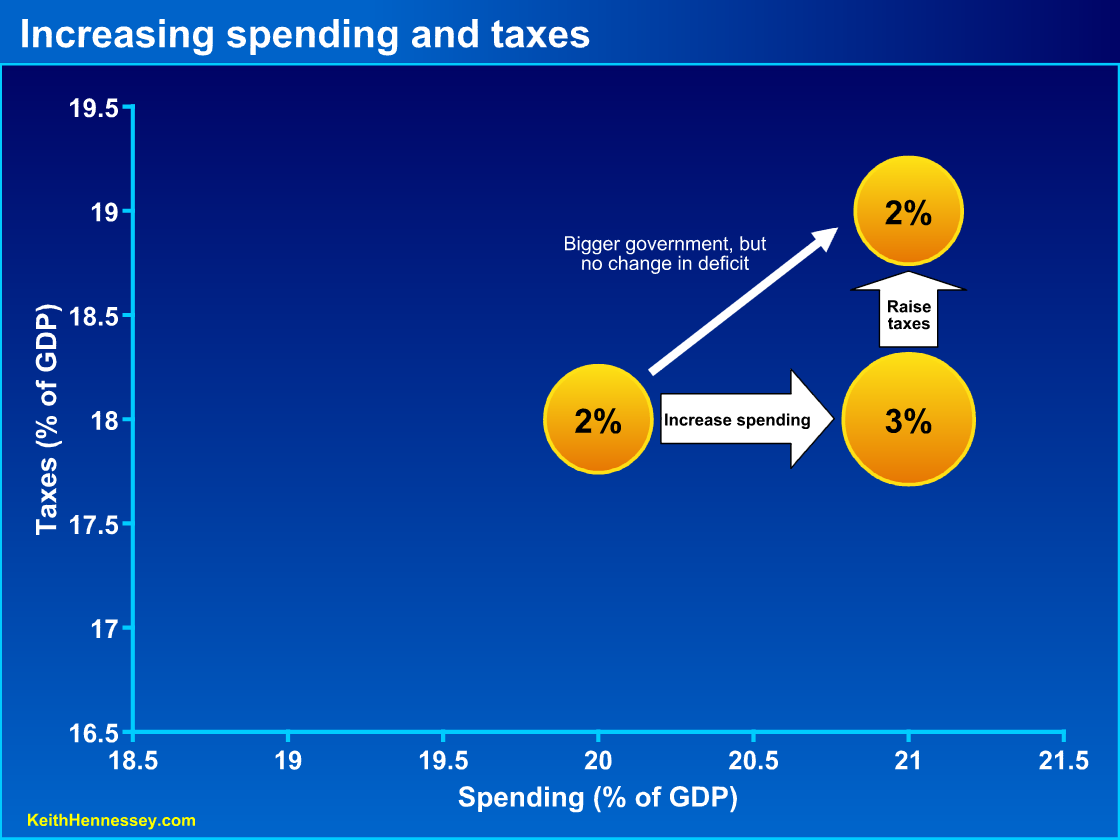
Under this logic, it’s OK to increase spending as long as you pay for it with higher taxes.  If you move 1 percentage point (or any other amount) to the right by increasing spending, you have to raise taxes by an equal amount.  The spending increase by itself would make the deficit bigger (2% to 3%), but the tax increase then reduces the deficit back to its original size.  Government is bigger (higher spending and higher taxes), but the deficit has not increased.

In political rhetoric this is labeled (generally by opponents) as tax-and-spend.  It’s probably better to think of it as spend-and-tax.

Here is where our budget bubble graph starts to get useful.  Advocates for these policy changes argue that, since the deficit is unchanged, this policy change has had no major economic effect.  “We have paid for our spending increase,” they argue, “our policy change does not increase the deficit”

True.  But this ignores that someone is paying higher taxes now.  By moving up we are making someone pay more to the government.  The right-then-up move illustrated above is a major fiscal policy change, and it is highly misleading to argue that it is insignificant because the deficit is unchanged.  This is the primary purpose of Budget Bubble Graphs – to highlight major fiscal policy changes that are obscured by a one-dimensional focus on the size of the deficit.

Some advocates (on both sides of the partisan aisle) focus on the deficit with the intent of obscuring a significant change in the size of government.  Many others in government and the press unwittingly ignore this component of major fiscal policy decisions.

In this example, the amount the government is borrowing from the private sector is unchanged, but the amount the government is taking from the private sector has increased.  Whoever is paying these higher taxes has fewer resources to pay their family bills or expand their business.  That is a significant consequence of this policy.

In addition, there is an economic efficiency loss from raising most kinds of taxes.  Economists call this deadweight loss.

I have described what PAYGO allows in this case.  It’s more accurate to think of PAYGO as a limitation.  The intent of this part of PAYGO is not to move up on the graph.  It is instead to prevent you from moving right without also moving up.  If you want to spend more (move right), you have to [cut spending or] raise taxes (move up) until your deficit bubble returns to its original size.  When followed it therefore precludes deficit-increasing spending increases.

A dangerous side effect of this philosophy is concluding that if this PAYGO philosophy allows something, it is therefore fiscally acceptable or insignificant.  I hope the above example demonstrates at a minimum that a big spending increase offset by an equally large tax increase is not insignificant.  I also think it’s bad policy, but that’s a value judgment on my part.

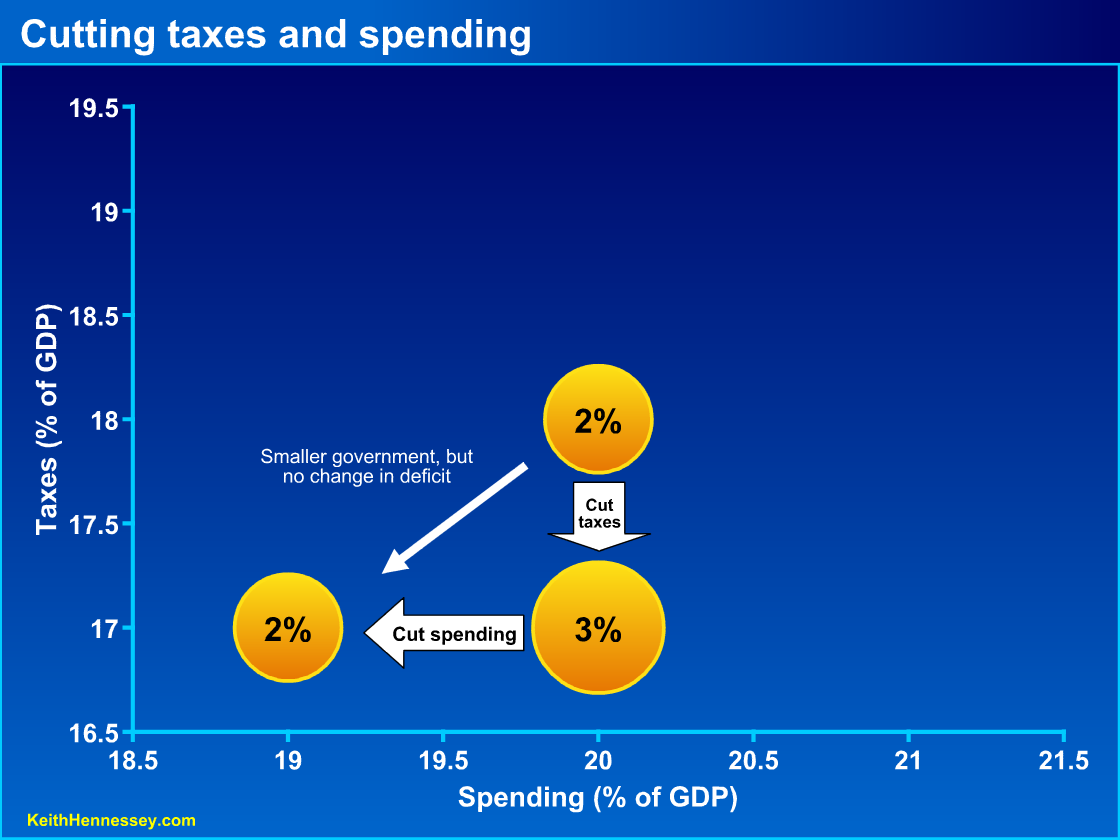
Now that’s just one side of the pay-as-you-go philosophy.  Here is the other side.
bbg-00e-cut-taxes-and-spending

Under this set of PAYGO rules favored by the President and many of his Congressional allies, you can move down (cut taxes) only if you also move left (cut spending).  It is again a limitation — you may not cut taxes (and thereby increase the deficit) unless you also [raise other taxes or] cut spending by at least an equal amount.  Once again, the details allow only cuts in certain types of spending to count, but we can ignore that here.

In this graph policy makers cut taxes by 1% of GDP, increasing the budget deficit from 2% to 3%.  They package this tax cut with spending cuts to keep the deficit at 2% of GDP.  The deficit is unchanged from the starting point, but government is smaller as measured by either spending or taxes.  Since the deficit is unchanged we have not increased future taxes.  Since taxes are lower now, individuals, families, and firms have more resources today to use however they best see fit.


In future posts we can examine the Republican view of the PAYGO world and why it’s so hard to get a bipartisan agreement to reduce the budget deficit.  Much of the partisan disagreement concerns proposals to move straight up or straight down on the graph, and we’ll look at that.  We can also use Budget Bubble Graphs to analyze different examples of major legislation now being debated as well as for other interesting analysis.

My point today is simply to introduce you to this type of graph and to use it to demonstrate that we should care about both the deficit and the size of government.  I have focused on the simplest examples to get you accustomed to using these graphs to help think about fiscal policy.

We have just scratched the surface of Budget Bubble Graphs.  Stay tuned for more.


Related Posts

(best matches are listed first)
  1. Does the President’s budget increase the deficit or reduce it?
  2. The President’s bigger budget
  3. Deficits & debt under the President’s budget
  4. What is a budget resolution?
  5. Does the President’s budget cut the deficit in half?
  6. Are taxes too low?
  7. Keeping up with the Joneses
  8. America’s long run fiscal problem is spending growth, not taxes
Twitter Digg Delicious Stumbleupon Technorati Facebook Email

This website uses IntenseDebate comments, but they are not currently loaded because either your browser doesn't support JavaScript, or they didn't load fast enough.

25 Responses to “Introducing Budget Bubble Graphs”

  1. Joshua Zucker 3 March at 7:16 am

    Nice post as always. It looks to me like you avoided the common distortion that can happen with this kind of graph; a lot of people make the diameter of the bubbles proportional to the number you are trying to portray, which exaggerates the size of the large ones, while you used area, which fits our perception better.

    Still I wonder if it might be better to use an ellipse of fixed width and stretch the other dimension in proportion to the number you are illustrating, so that you can see more easily that 3% is three times 1%.

    • Perceptive as always. If my graphing program (SwiffChart, it's phenomenal) allowed me to do ovals I would use them. Alas, I'm stuck with circles, although it did give me the choice between scale by diameter and scale by area.

      • Bob Bradford 11 March at 9:42 pm

        Keith, I'm always looking for a good way to show data in ways that don't hide the real plicy options. This is really good stuff; I don't think we learned this in highschool.

  2. Excellent post Mr. Hennessey! I'm looking forward to seeing the bubbles in action in real policy analysis

  3. Nice! Good use of this type of graph and a good tool for looking at future proposals.

  4. Great post, the bubble graphs are a great tool. You addressed it somewhat but one thing in the partisan debates that bothers me is the monolithic use of static scoring. The difference between raising tax rates and raising tax revenues. Since changing rates has economic effects (as you pointed out), it's not possible to predict precisely how revenue will be effected by changes to the tax rate.

    Any reading suggestions on the results of research done on this? I have read some things that indicate that tax rate decreases have tended to be followed by increased tax revenues. But I would love to read something geared to the layman but done by a pro that has researched this.

    • Excellent point. I look forward to more discussion on this subject.

      I read an analysis a few years ago that said the most important element in government fiscal policy is total government spending (the less the better, economically). Taxes and deficits matter, but not as much as total spending. That theory is consistent with the 90's boom when spending was restrained.

  5. I'm glad you touched on this subject, Keith, and as usual your presentations are very clear and substantive. I'm really impressed with the sheer quantity of your posts too! I have two points to make:

    1) You focus on the fact that bigger government is undesirable because the higher taxes required to support it creates a "deadweight loss" in productivity. But there is perhaps an even greater loss of efficiency that comes from the spending side. In Milton Friedman's formulation, government spending is essentially the spending of other people's money on other people and is the least efficient form of spending. As a spending decision is a concrete decision about how available resources are allocated, growing the fraction of GDP that is government spending increases the fraction of our productive resources that are utilized inefficiently; (continued)

  6. (continued from above)
    2) You are still using language appropriate to an economy rooted in a gold standard rather than a fiat currency. The federal government does not tax in order to raise revenues, and it does not borrow from the private sector in order to spend. Taxes are used to remove government IOUs (cash or Treasuries) from the system to dampen aggregate demand, prevent inflation, and support the value of the dollar. Treasuries are issued to soak up money that the government has spent and to provide a positive interest rate on excess cash, which encourages savings and dampens current aggregate demand. This is a discussion for another time, and I'd love to see you address the topic, but we have to stop thinking of the public debt as something that has to be repaid by taxpayers.

  7. Vinyl Slider 3 March at 5:25 pm

    These charts will be useful in policy analysis, but would you be kind enough to expound on the implicit assumption that there should be any bubble? Yes, in times of war or recession one could argue for a *temporary* bubble, but over a long period of time (in this case since the end of WWII as you state), the bubble should essentially be zero, not average 2%.

    In other words, there are a growing number of us who believe the upper left arrow is the only honest path that can be chosen until the bubble is essentially a dot (i.e., 0%). The graphing method is still valid for policy choices based on the 0% dot, but those policy choices should tend toward the lower left arrow until the debt is significantly reduced. While debt is okay for public investments with some potential payback in the future (transportation, universities, research), certainly no one can argue that debt (especially increasing debt) for consumption (social security, medicare, reckless stimulus) is a good idea?

    Other than Paul Ryan and Ron Paul, does anyone else in Washington understand this?

    • Vinyl, there is no fundamental difference between Treasury bonds and cash (or numbers on a spreadsheet at the Federal Reserve). They are all IOUs of the federal government, i.e. money. Don't you think that as our population grows, as our producitivty grows, as our economy grows that we need more money to sustain our economic activity? On top of that, most economists will tell you that it is healthy to have a modest level of inflation of around 2% per year. In order to achieve that the government needs to create money at a certain average rate that is significantly greater than zero. A good metric (although perhaps not the best) is to target a constant ratio of money/GDP. If we want this ratio to be aroudn 50%, and we want 2% inflation and 2% real GDP growth, then we need 0.5*(2%+2%) = 2% of GDP growth in government IOUs every year. This means 2% of GDP budget deficits, on average.

  8. Great graphs, it's difficult to portray complicated information simply, and that is what you've achieved. The problem of course is that the graphs only go in one of two directions, either up and to the left (Democrats increase spending and taxes) or down and to the left (republicans increasing spending and reducing taxes).
    If one party was genuinely interested in reducing spending (ala Paul Ryan's proposal on Medicare) then it would be helpful, but after the howls of indignation from the Republicans on cutting Medicare Advantage as part of HCR you can't take them seriously as a part of fiscal responsbility

  9. Vivian Darkbloom 3 March at 7:58 pm

    So far, so good. But now that you have set out the playing field, let's move on to define the strike zone.

  10. Nice post. You would agree, though, that certain taxes and fees (on bads instead of goods) actually improve economic efficiency, right?

  11. Keith,

    One important factor that your graph does not address: subsidies in tax expenditure form. Suppose we eliminated the mortgage interest tax deduction and instead government just sent homeowners (with tax liability) a government check of the same amount with the same timing of cash flow as they'd have via the tax deduction. Nothing substantive would have changed (not incentives, not financial impact on anyone, not the basis for those financial effects on various parties, etc.), yet your chart would misleadingly imply a substantive difference, with the tax deduction (tax expenditure) form of subsidy scenario looking like a "smaller government" with lower taxes and lower spending.

    Another example is offered by Bruce Bartlett at http://capitalgainsandgames.com/blog/bruce-bartle...
    Tax expenditures are a huge loophole through which spending can be driven. For example, instead of spending $1 billion to buy some new equipment for the Army, the government could give the contractor a transferable, refundable tax credit worth $1 billion. Even if the contractor had no tax liability, it could simply sell the credit to some business that had at least a $1 billion tax liability. There would be no increase in spending as conventionally measured and taxes would simply be $1 billion lower.

    Taken a step further to end up deficit-neutral, Bruce's example means that other taxpayers must pay $1 billion more regardless of whether that subsidy had taken the form of a tax expenditure subsidy or an explicit "spending" subsidy.

    Also, from the Tax Policy Center:

    the rapid growth in what economists call “tax expenditures” and “targeted tax credits.” These policies use the tax code to implement social and economic policy instead of traditional government spending. Lawmakers have come to prefer tax expenditures and credits in recent years because they are less transparent to taxpayers, face less budgetary scrutiny, and allow lawmakers to funnel taxpayer dollars from one group to another without facing criticism that they are big-spending politicians.

    At the federal level there are myriad examples of this trend. The Earned Income Tax Credit (EITC) dispenses aid to low-income Americans through the tax code rather than direct welfare. Similarly, the Child Tax Credit gives generous subsidies to parents through the tax code rather than through direct welfare payments.

    And various targeted tax credits offer a wide range of tax bonuses to companies that produce alternative fuels, locate in politically favorable areas, or engage in other activities deemed worthy of subsidy by Members of Congress.

    These special “tax expenditures” blur many traditional lines between taxes and spending, making it more important than ever to examine all public finances—both taxes and spending. http://www.taxfoundation.org/files/sr151.pdf

  12. My write-up on this topic (including a translation of the relevant part of Obama's State of the Union address) is at http://dmarron.com/2010/02/08/the-problem-with-ta...

    • Brooks, this is an excellent point. The Democrats, starting with Bill Clinton I think, have been very savvy to relabel subsidies and spending as "tax cuts." Of course, it is somewhat difficult to tease out the real tax cuts from the spending. How do we know which is which? In some cases, I guess, it is fairly obvious. Using Bruce Bartlett's example, if the government were to buy the Army 1,000 tank engines from GE in exchange for tax credits, that's clearly spending. I'm skeptical that any bureaucrat or politician has been brazen enough to exchange tax credits for goods and services and call it tax cuts though. I think the more practical test to be used is whether the so-called tax cuts are targeted. I submit that true tax cuts are broad based and applied to income generally, consumption generally, property generally, or trade generally, and not focused on any particular type of economic activity. Targeted tax cuts are therefore subsidies, just as targeted tax hikes are fees.

      • Thanks. Yes, the nature of the basis for the provision (what determines who gains from it) matters. If the offer is "If you buy X, you'll end up with $Y more than you would without this provision (and the other taxpayers will end up with $Y less*)", then it's a subsidy, regardless of whether it's done via tax deduction or via an explicit "spending" subsidy, and that's the clearest case of a subsidy. Whatever one thinks of the merits of it (in terms of positive externalities, added "fairness" to our fiscal policy, etc.), its merits are substantively the same regardless of which form it takes.

        Same for "If you have another child" or "if you have your employer pay you partly in benefits (e.g., health insurance) rather than all in cash".

        One could point to some conceptual gray areas and question how distinct they are from tax expenditure subsidies, but usually those items are different in that they leave the beneficiary of the provision better off based on their level of income, not based on choices like what purchases they make. For example, we cap Social Security FICA taxes. One could say that this cap represents a "tax break" for income above the cap, since the earner of that income ends up with more money (after taxes) than he would if there were no cap. But one point that shouldn't be lost is the difference between one being able to benefit from that provision based on his income level vs. being able to benefit from a provision based on some choice he made (buying a home; sending a kid to college; having another kid; getting compensation in the form of benefits; etc.). And the other point that shouldn't be lost is, again, the equivalence of the latter to the same subsidy via explicit "spending".

        One can even argue that our tax code is made "fairer" or "better" in some other way (vs. just having the tax brackets and rates without various deductions for buying X, etc.), but again, that's no different from arguing that we should do the same thing via explicit "spending" subsidies to make our overall fiscal policy "fairer" or "better" in some other way. Whatever the merits are, the form the subsidy takes is irrelevant in terms of substance (it's relevant in terms of politics and their treatment in the budgeting process, but that's only because of the misconception that there's a substantive difference — the result is that subsidies as tax expenditures are more likely to be created, increased, or maintained).

        * or Y less some amount resulting from revenue feedback effects resulting from your purchase; the possible adjustment doesn't affect the conceptual point.

  13. Can you add the total deficit as a percent of GDP as a bubble in the background so we can guage the cumulative impact over time?

  14. What a marvelous post! I guess the only thing I might also love to see in this presentation is the effect of state and local spending since I these too are government spending and many people I know tend to keep them out of discussions as well. If one looks at TOTAL government spending- e.g. local, state and federal- it is a much larger % of GDP than most people care to admit.

  15. Ebenezer Scrooge 12 March at 4:31 am

    "Whoever is paying these higher taxes has fewer resources to pay their family bills or expand their business."

    This statement is not tautologically true, except maybe to anarcho-libertarians. Higher taxes can buy more services. If you like the services–and the state is the least-cost provider–you actually get MORE resources from the higher taxes.

    Most Republicans agree with this, when the services are things like police and soldiers. It is a damn sight cheaper to pay for a military than keep a small arsenal in one's backyard. Many Republicans even agree with this when the services are things like roads and schools. Democrats go a bit further, and think that things like health care can be cheaper when bought by the state. So everybody (except the anarcho-libertarians) should agree: Keith Hennessy is wrong.

    Mr. Hennessy is a smart guy, and knows this. However, he is ultimately trying to enlist Mr. Science to support the Republican Way. Sort of like David Brooks. Hence, the subtle misleading statements.

  16. So now we have bubble graphs and the Tea Party movement, which is concerned with the size and location of those bubbles. I can see it now — the "Bubble Tea Party movement"!

    (for anyone unfamiliar with bubble tea and who therefore didn't get the joke, see http://en.wikipedia.org/wiki/Bubble_tea )