
Which is the decade of profligacy?

President Obama released his budget proposal yesterday in the Grand Foyer of the White House.  He said:

Good morning, everybody.  This morning, I sent a budget to Congress for the coming year.  It’s a budget that reflects the serious challenges facing the country.  We’re at war.  Our economy has lost 7 million jobs over the last two years.  And our government is deeply in debt after what can only be described as a decade of profligacy.

The fact is, 10 years ago, we had a budget surplus of more than $200 billion, with projected surpluses stretching out toward the horizon.  Yet over the course of the past 10 years, the previous administration and previous Congresses created an expensive new drug program, passed massive tax cuts for the wealthy, and funded two wars without paying for any of it -– all of which was compounded by recession and by rising health care costs.  As a result, when I first walked through the door, the deficit stood at $1.3 trillion, with projected deficits of $8 trillion over the next decade.

I will set aside the question of the propriety and political wisdom of continuing to attack one’s predecessor more than one year after taking office.  I will instead focus on the substance of President Obama’s argument, and in particular his claim of a “decade of profligacy.”

Medicare benefits and tax cuts

It is true that 10 years ago we had a budget surplus of more than $200 billion, and that CBO projected surpluses “stretching out toward the horizon.”  When CBO built its budget baseline for 2001, they had not yet accounted for the bursting of the late 90’s tech stock market bubble and the effect it would have on federal revenues.  Like families, businesses, and investors, CBO made a mistake:  they projected future revenue growth that was never going to occur.  Critics of the Bush Administration hinge their comparative argument on this single mistaken budget projection which in hindsight analysts from both parties acknowledge was wildly inaccurate.

It is also true that President Bush proposed, and in 2003 the Congress passed and President Bush signed into law, a Medicare drug benefit that was not offset by other spending cuts or tax increases.  It is true that this benefit significantly increased the already large unfunded liabilities of Medicare.

What the Democratic critics fail to mention is that the Democratic alternative proposal cost significantly more than the Bush proposal and the enacted law.  (This predates Mr. Obama’s time in the Senate.)

What Republican critics fails to mention is that in the late 1990’s a Republican-majority House of Representatives passed a Medicare drug benefit without offsetting the proposed spending increases.  Senate Republicans offered their own version on the Senate floor, which again was smaller than the Democratic alternative.  By the time then-Governor Bush began his Presidential campaign, there was a broad bipartisan Congressional consensus to create a universally subsidized prescription drug benefit in Medicare without offsetting the proposed spending increases.  Bush joined that consensus and enacted it into law.  Fiscal conservatives should direct their anger principally at House and Senate Republicans of the late 90’s.  (I worked in the Senate then, so I get blamed either way.)

It is true that President Bush proposed, and in 2001 and 2003 the Congress passed and President Bush signed into law significant tax cuts, and that those tax cuts were not offset by spending cuts or tax increases.  If President Obama believes that enacting these tax cuts without offsetting their deficit impact was profligate, then why is he proposing to do the same thing?  His budget proposes to change the law to extend all of the Bush tax cuts except those Team Obama mislabels as “for the rich.”  He is not proposing offsets for those tax cuts he would extend.  It is inconsistent to argue that Bush was irresponsible when he did it, and that Obama is responsible when he does the same thing.

Given my concessions, it must be true that the 00’s were a decade of profligacy, and that President Obama’s policies will “restore fiscal discipline in Washington.”  Right?

Comparison

Let us examine the results of these so-called “profligate” policies during the Bush Administration, and let’s compare them to the deficits proposed by President Obama.  I will compare eight-year Presidential terms rather than decades.  In doing so I will assume that President Obama gets a second term, and that the budget he proposed yesterday is enacted exactly as proposed.

When doing this comparison one has to struggle with how to treat fiscal year 2009, which began October 1, 2008 and ended September 30, 2009.  A traditional comparison would assign budgets for FY 2001 through FY 2008 to President Bush, and for FY 2009 through FY 2017 to President Obama, since usually the bulk of the laws signed in FY 2009 would be signed by President Obama.

But this would assign all the “blame” (deficit impact) of TARP to President Obama.  I am therefore going to calculate deficits for President Bush including FY 2009, as those deficits stood on January 20, 2009 when he left office.  In doing so, I am assuming the overwhelming majority of the TARP spending and their deficit “blame” to President Bush, even though he committed only half the $700 B TARP.  In other words, I am skewing my analysis to be as generous as possible to President Obama in the comparison with President Bush.  (Update:  See below for a caveat on the light blue Obama bar, which also includes all of 2009.)

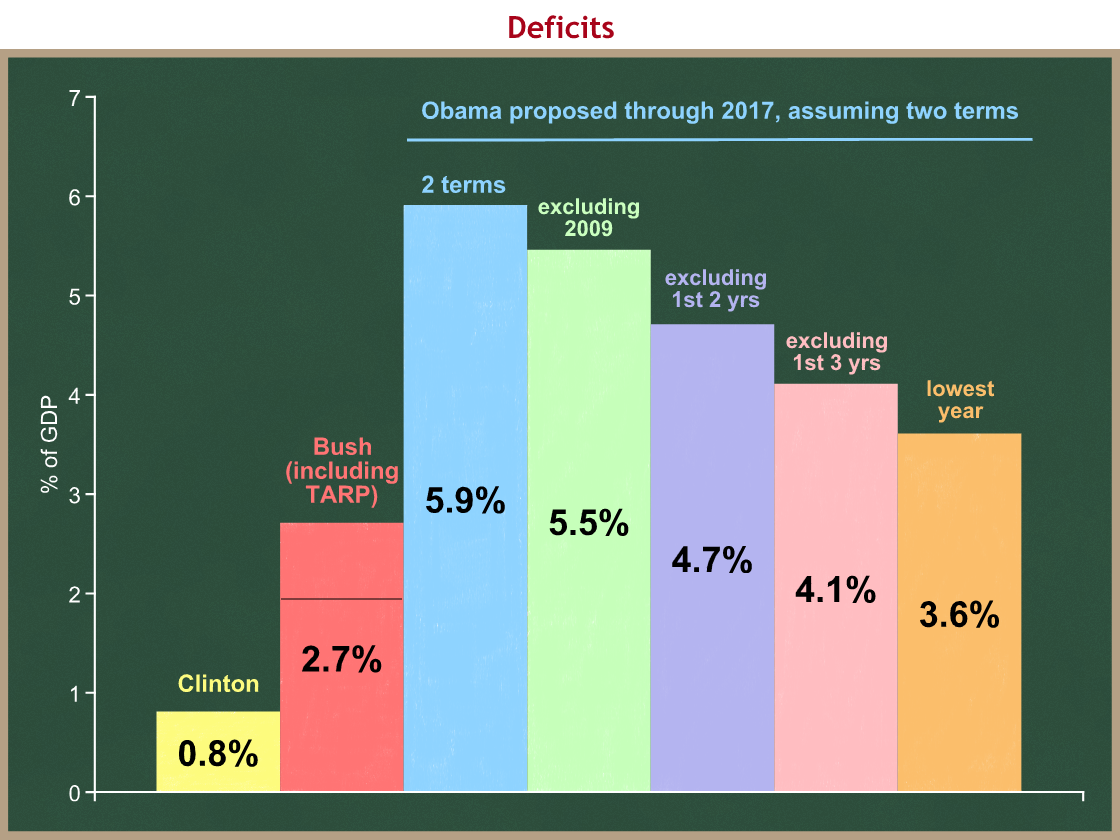
Here are the average budget deficits measured as a percent of GDP.  As always, click on any graph to see a larger version.
deficits-comparison

You can see that budget deficits during President Clinton’s eight years averaged 0.8 percent of GDP.  Clinton folks will tell you this is because of his brilliant policies, and in particular the 1993 budget law.  I think most of it is the result of tech bubble-induced higher capital gains revenues causing total taxes to surge to record levels.  We can have that debate another time.

If I measure President Bush for the nine year period 2001-2009, thus assigning almost all TARP spending to his Presidency, I get an average budget deficit of 2.7% of GDP.  (Historical umbers are from OMB’s historical tables.  Obama numbers are from Table S-1 in his new budget.)  In calculating this nine year average I am adding the horrible FY 2009 into the Bush average, using CBO’s projection for the FY 2009 deficit of 8.3% when President Bush left office in January 2009.  Bush therefore gets the deficit hit for most of the TARP, but Obama gets the hit for his stimulus law and the further economic deterioration when he was in office, both of which pushed the actual 2009 deficit to 9.9% of GDP.

You can see a black line within the Bush column.  That’s at 2.0%, the average Bush deficit for the eight year period of 2001-2008.

Now let’s turn to President Obama.  Remember, we are measuring his average budget deficit through FY 2017, assuming he stays in office for two terms and his new budget is enacted as proposed.  I am also being generous by using OMB’s scoring of the President’s budget.  CBO is always more pessimistic and would make the Obama numbers look worse.

President Obama’s proposed deficits over the eight-year period FY 2009-2017 are 5.9% of GDP, the light blue bar.  That’s more than twice as large as the Bush nine year 2.7% average, and almost three times as large as the Bush eight year 2.0% average.  Update:  This calculation assumes the full 9.9% FY 2009 deficit in the average, thus it includes the TARP spending and in a sense overlaps with the Bush red bar.  The TARP money is being counted with each of them.  The next three bars “solve” this problem by excluding all of 2009 (including TARP and stimulus) from the Obama average.

I can imagine someone replying that it’s not fair to blame President Obama for the big deficits we are running as we recover from a severe recession.  The next three bars therefore exclude the first one, two, and three years of an assumed eight year Presidency.  Surely no one can argue that President Obama should not be held responsible for the budget deficits in years four through eight!

You can see that each of these comparisons, which allow you to “not count” the recovery years in the average for Obama, still result in average budget deficits that far exceed even the worst portrayal of the Bush Administration’s average.

In fact, the smallest annual deficit proposed by President Obama is 3.6% of GDP, in 2018 and 2019, the two years after his second term would end.  The lowest during his hypothetical eight years would be 3.7% in 2017 and 2018.  The lowest proposed budget deficits in a hypothetical “Obama decade” would exceed the Bush average budget deficit, even if we assign most of the TARP spending to Bush.

This leaves an open question:  Which is the decade of profligacy?


Related Posts

(best matches are listed first)
  1. More on the decade of profligacy argument
  2. Should we care about deficit reduction or deficits?
  3. Ten years ago? Seriously?
  4. The President’s bigger budget
  5. The President’s 2010 challenges: jobs, deficits, and taxes
  6. Does the President’s budget increase the deficit or reduce it?
  7. The President’s new economic proposal
  8. Six month economic policy status update
Twitter Digg Delicious Stumbleupon Technorati Facebook Email

This website uses IntenseDebate comments, but they are not currently loaded because either your browser doesn't support JavaScript, or they didn't load fast enough.

73 Responses to “Which is the decade of profligacy?”

  1. I'm not sure how it makes Obama look better to complain that Bush overspent when Obama hasn't stopped any of that spending, and Obama plans to spend buckets and buckets more. And let's not forget that we're comparing Bush's record with a projection of Obama's FIRST budget. How many more expensive ideas will Obama have in his next seven years? Bush is finished; Obama is only getting started.

  2. I'm not sure how it makes Obama look better to complain that Bush overspent when Obama hasn't stopped any of that spending, and Obama plans to spend buckets and buckets more. And let's not forget that we're comparing Bush's record with a projection of Obama's FIRST budget. How many more expensive ideas will Obama have in his next seven years? Bush is finished; Obama is only getting started.

  3. Keith,

    You are also being overly harsh on Bush by not mentioning that he inherited a collapsing stock market bubble and a recession. The recession was only mild because of Bush's exquisitely timed tax cuts (whose impact was miraculously being felt right around the time the nation was in shock from the 9/11 attacks).

    The CBO's projection of trillions of dollars of budget surpluses back in 2000 was unbelieveably ignorant. It is simply impossible to wipe out that much private sector net financial wealth (yes, that's what the public debt is, along with federal reserve deposits and cash currency — it is the accumulated savings of the private sector) and not suffer a depression. If anything, Bush's deficits were on the small side. After all, it is the public debt as a % of GDP that matters, and that did not rise to unreasonable levels under his administration (50% or so), even if you count fiscal year 2009 against him. But Obama's plans on the table will push the public debt to close to 100% of GDP, which although low compared to Japan, and even many countries in Europe, is probably too high for the US.

    -ESM

    • There are several aspects of the above analysis in which I leaned against my former boss (Bush 43), in an attempt to overprotect this analysis from accusations of bias. I wanted to show that, even if one gives President Obama the benefit of the doubt on every judgment call of the comparison, my conclusions still hold.

  4. All defense outlays, including all "costs of the wars" are included in the Bush figures.

  5. As relates to Clinton, my post is largely correct and I am agreeing with you that he did run surpluses. He also grew the debt. Counterintuitive and a matter of government accounting.

    As it relates to Obama's inheritance, he is free to change any component of it (except interest) at any time. He absolutely can cut spending but he chooses not to. He is our President and his budget is his choice. But to say he has no choice is a fallacy of the highest order.

    His budget already projects substantial tax raises. Tax receipts of the government would more than double from 2010 to 2020. Look at differently, tax receipts would exceed 20% of GDP without the capital gains bonanza that occurred in the 1990s which is the last time they were at that level. On an apples to apples basis, it's an increase of about 3% of GDP and yet; despite this, his budget projects substantial shortfalls in perpetuity despite tax increases and a projected rapid recovery, consistent growth and low inflation.

    All of which brings me back to the initial point. President Obama is seemingly committed to higher deficits and higher taxes than any President in the history of the United States. I find the prospect disturbing but apparently you do not

    • Steve,

      "As it relates to Obama's inheritance, he is free to change any component" You're joking? Cut and run in Afghanistan and Iraq? How shall he reverse financial armageddon brought upon us by banks and government (Clinton + Bush)? That is a joke or?

      I think no president likes high deficits and high taxes per se. And no one is certainly commited to such an endeavour. This is nonsense. The budget is simple born out of necessity and everybody is crying wolf because suddenly someone dares to make a frank finacial statement.

  6. SukieTawdry 3 February at 9:51 pm

    "It is true that 10 years ago we had a budget surplus of more than $200 billion…"

    Is it? Can you claim a budget surplus when spending increases the national debt? Because the national debt increased every year Clinton was in office. While it's true that public debt was paid down, it was accomplished by intragovernmental borrowing that had the net result of increasing the national debt. You may argue the relative wisdom of such a policy, but, it seems to me, you can't claim a budget surplus. Isn't it long past time that we put this myth to rest?

  7. This is Jonathan Chait's takedown of this article:

    Former George W. Bush economic advisor Keith Hennessey is tired of the Obama administration dragging its predecessor's name through the mud. So rather than simply imply or assert that President Obama's fiscal record is worse than George W. Bush's, like most conservatives do, Hennessey actually tries to make the argument that Obama's policies are more profligate than Bush's.

    I remember Bush's fiscal policies, and the political environment that surrounded them, pretty well. In the wake of the Bush administration's collapse, its defenders have been mostly laying low, trying to make their man look good by taking passive-aggressive shots at his successor. I've been waiting for Bush's loyalists to try to rewrite the past. So consider this fisking the beatdown that was nine years in the making.

    1. Hennessey begins by saying that the Bush administration got blindsided by optimistic budget projections:

    It is true that 10 years ago we had a budget surplus of more than $200 billion, and that CBO projected surpluses “stretching out toward the horizon.” When CBO built its budget baseline for 2001, they had not yet accounted for the bursting of the late 90’s tech stock market bubble and the effect it would have on federal revenues. Like families, businesses, and investors, CBO made a mistake: they projected future revenue growth that was never going to occur. Critics of the Bush Administration hinge their comparative argument on this single mistaken budget projection which in hindsight analysts from both parties acknowledge was wildly inaccurate.

    Here's what actually happened.

    As budget surpluses appeared in the late 1990s, some level of giddiness crept into the thinking of both parties. But it was the right that went completely overboard. Conservatives were writing books like "Dow 36,000" and insisting prosperity would last forever. You might think it's odd that the right would be hyping prosperity during a time when a Democrat held the White House. But the giddiness had a political purpose: it was useful to disarm Democratic fears that tax cuts might weaken America's fiscal position.

    In 2001, when the Bush tax cuts were being debated, liberals and Democrats warned over and over again that CBO's forecasts could prove ephemeral. TNR editorialized,

    it is true that the budget has produced pleasant surprises for several years running. But the proper lesson to take from this is not that budget projections are always too conservative–indeed, historically they've usually erred on the side of optimism–but that they're not very accurate.

    Paul Krugman warned about the possibility in his book, Fuzzy Math: "If the 'new economy' turns out to have been a sprinter rather than a marathon runner, the CBO's projections of revenue will turn out to be greatly exaggerated.'

    Republicans successfully dismissed such fears. They insisted that the CBO, run by musty old Keynesians who failed to appreciate the wonders of the dynamic new economy, was dramatically understating the surplus. "Economist Lawrence Kudlow has been the nation's most accurate fiscal prognosticator of the last decade," wrote Stephen Moore, "and he estimates tax surpluses will be twice as large as the official forecast." They further proclaimed that the Bush tax cuts would unleash even more growth, meaning that the CBO forecasts must be too pessimistic. Martin Feldstein testified, "The true cost of reducing the tax rates is likely to be substantially smaller than the costs projected in the official estimates." In his 2001 State of the Union speech advocating tax cuts, Bush cleverly spoke as if the surpluses had already materialized, and the proceeds been salted away:

    We have funded our priorities. We paid down all the available debt. We have prepared for contingencies. And we still have money left over.

    The Bush administration furiously and successfully beat back Democrats' attempts to inculcate caution and modesty about the projected surpluses. To cast the administration as victims of a "mistake" requires a a staggering level of chutzpah.

    2. Next, Hennessey admits that, sure Bush pushed through a prescription drug benefit, but everybody else would have done the same:

    By the time then-Governor Bush began his Presidential campaign, there was a broad bipartisan Congressional consensus to create a universally subsidized prescription drug benefit in Medicare without offsetting the proposed spending increases. Bush joined that consensus and enacted it into law.

  8. Wow ESM, what a posting.

    Republicans were shouting Dow 36,000 especially if his tax cuts were done, now they are responsible for preventing a "depression" that was nowhere in evidence at the time (unless you think an internet tech bubble is equivalent to…I don't know… a multi-trillion dollar housing bubble, and the collapse of Lehman Brothers, Morgan Stanley, etc.) You can blame part of it on Clinton (re: gutting Glass-Stiegel), but the meltdown happened in year 8 of the Bush Presidency, if he can't own that then all notions of Republican responsibility are an utter lie.

  9. So let me see if I have this straight- the 'tech bubble' was a pernicious bubble that inflated Clinton era tax receipts, while the residential real estate bubble which gets mentioned all of 0 times here, and was by any measure at least an order of magnitude larger than the tech bubble, did not inflate Bush era tax receipts. Do I have that right? Quite the braintrust you have here.

    But the mountainous deficits bequeathed to Obama and subsequent administrations weren't the Bush administration's sole domestic acheivement. Far far from it. One also must factor in the criminal negligence of fiscal, regulatory and monetary policy that allowed the bubble to become the most obscene in the history of the world in the first place.

    Of course, that development has had huge private sector as well as public costs, mainly by the gross misappropriation of resources and massive opportunity costs- in evidence by the millions of Americans left screwed to the wall in the Bush administration's totally awesome wake.

  10. I do believe when people begin to get a sense for how badly you all screwed the pooch, and how costly it will be to them and their children and children's children, that you will spend the rest of your days on the lam and incognito. Decade of profilgacy nothing. The noughties were the decade of rank insanity.

  11. right on majorajam. the Jobs and Growth Tax Relief Reconciliation Act of 2003 ("JGTRRA", Pub.L. 108-27, 117 Stat. 752), was passed by the United States Congress on May 23, 2003 and signed by President Bush on May 28, 2003. This while we were at war and long after 9/11…I wonder how that worked out? I love this from a speech by Dick in 2006: Our economy today is healthy, and vigorous, and growing faster than that of any other major industrialized nation. Since August 2003, America has created over 4.7 million new jobs.
    Amazing, I had no idea the Bush administration began in August of 2003. As to those 4.7 million new jobs, up in smoke. An economy based on speculation and housing bubbles, not so good.
    And there is this from that speech:
    the President’s recently submitted budget would create a new Dynamic Analysis Division within the Treasury Department to analyze major tax proposals. The evidence is in, it’s time for everyone to admit that sensible tax cuts increase economic growth, and add to the federal treasury.

    He is right, the money flowed and flowed, right into the coffers of the Chinese Government. Maybe when Papa Bush was in China, baby Bush was kidnapped and turned into the real Manchurian candidate. After all, he was the best American President China ever had.

    This Dynamic Analysis division predicted that permanently extending the President’s tax relief
    enacted in 2001 and 2003 likely would lead to a long-run increase in the capital stock and an
    increase in national output in both the short run and the long run.

    Hmmm…because it didn't, it must be Obama's fault, or Clinton's, how about Carter? The Republican version of the ownership society: We create debt and economic downfall, the Democrats will own it.

  12. Baroo Bahama 5 February at 2:14 am

    LOL, you hack

  13. ConorClockwise 5 February at 4:23 am

    What a horrible post, Hennessey. You also don't include the Iraq an Afghanistan Wars? Your lies are as big as Bush's.

  14. when ronald reagan was running for president the first time, he pledged to reduce the income tax by 25% if he was elected. in my opinion, he bought the presidency–and that's when the mess we're in today started. many people–republican and democrat alike–place high value on him as the "great communicator." at the time i could not see how cutting taxes 25% without corresponding spending cuts would be good for the country. within a short period of time, it became obvious one can't be done successfully without the other.

    junior comes into office and proceeds to give us lower taxes, increased spending, and a dubious war and, subsequently, another one. both, however, were not contained within any budget after 9/11 of his administration. they became offline items. all to prove he could do what daddy didn't do–kill saddam hussein.

    today president obama struggles to clean up and fix what was left to him. if i had had my way, he would have been president the day after he was elected in 2008 because he did have a battle here at home that was/is going to be more difficult to win than either iraq or afghanistan. not because he's incapable, has bad ideas, or totally wrong in his assessment of the situations with which he has to deal, but because republicans in congress and without are doing everything to put unnecessary and irresponsible roadblocks in the way.

    my own representatives are proud of the fact that they vote 90-100% as they are told by the leaders within their party. they are incapable of thinking for themselves. congressman todd tiahrt ran with term limits as one of his campaign promises; however, he is now running for U.S. senator from kansas. senator sam brownback, who is gone almost as much as he's in washington "doing the peoples' work," is running for govenor, and is running unopposed because our own democrat party is doing little to encourage and support democrats to run against him.

    my point is if my congressional representatives are as do-nothing as they appear and as their party displays it doesn't matter whose mess we're in. pointing figures doesn't solve the problems. creative, workable, bi-partisan, innovative solutions are what are needed. i'd like to see less he said, he said and more he suggested and i agreed or i suggested a compromise.

    these kinds of articles do nothing to solve the problems. it doesn't matter what george bush did, should have done, or didn't do. what matters is how the problems are fixed and when and how better are country becomes as a result.

  15. If the world of Wash. DC was a place of actual accountability, that is a true market for cause-and-effect reality, all economic advisors under Bush/Cheney would have by now retired in quiet hermetic shame to another profession where their mistakes would not cause any more havoc. Or committed hari-kari to preserve their good names for the sake of family members. All other commentary from these people is self-serving nonsense.