
Here is President Obama in the Rose Garden last Friday:
Today we’re pointed in the right direction. We’re losing jobs at less than half the rate we were when I took office.
There is a difference between “good news” and “pointed in the right direction.” Friday’s jobs report was good news, but the economy is still not yet pointed in the right direction. We have a ways to go.
Beginning with his weekly address on August 1st the President has been saying that the economy is “pointed in the right direction” or “headed in the right direction.” He said this first after the 2nd quarter GDP report showed a 1.1% decline, and again after last Friday’s jobs report showed the U.S. economy lost 247,000 jobs in July. The President is making a common error by looking at the rate of change of a rate of change.
Here is the graph that shows why the President’s language sounds plausible. The vertical axis shows the net change in how many people were working from the previous month. (Click on any graph to see a larger version.)
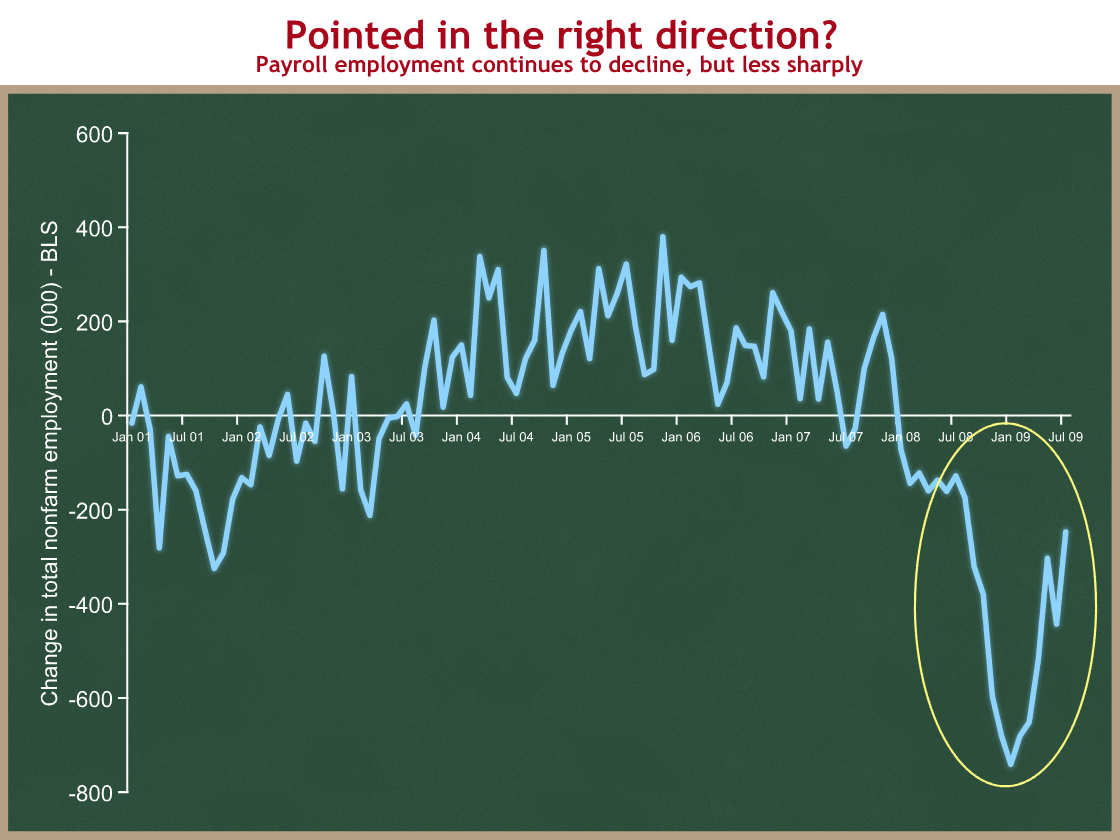
The yellow oval shows why the President is saying “we’re pointed in the right direction.” Aside from the sharp one month drop in June, this graph is headed up from its low point in January 2009. You can see from this graph that for the first two-thirds of 2008, the economy was losing about 150,000 jobs each month. The bottom then dropped out, and we lost 741,000 jobs in January 2009. In July the economy lost 247,000 jobs. Things are getting better, right?
Wrong. Things are still getting worse, but less more slowly. The mistake is looking at the direction of a trend on a graph of a rate of change. When you’re looking at a graph that displays a rate of change, “things are getting better” if the latest point is above the horizontal axis, and things are still getting worse as long as you’re below zero. The economy is still losing jobs, and so we are not yet “pointed in the right direction.”
It’s easiest if I show you a different graph. Looking at the same timeframe, let’s graph levels of employment – how many people are working at any point in time.
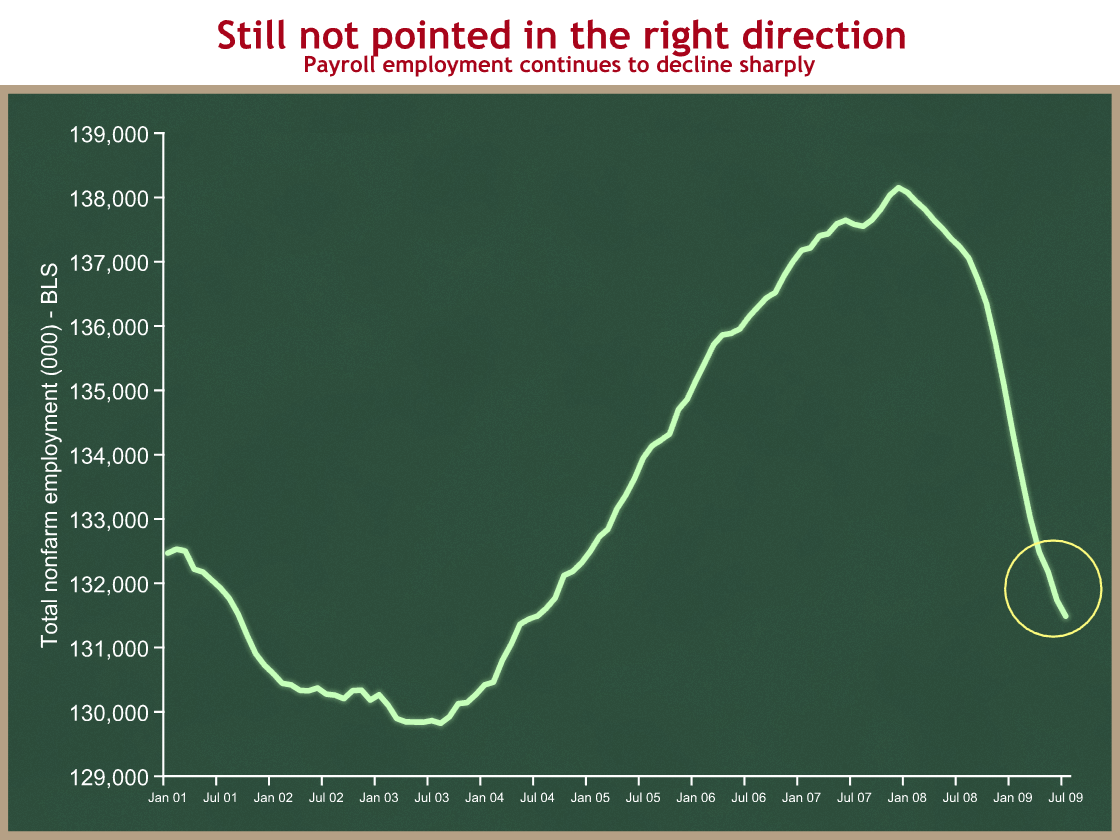
You can see from this graph that employment peaked in December 2007 and has been steadily declining since. The employment levels turns downward when the rate of change crosses into negative territory, in January 2008.
If you look closely at the yellow circle, you can see that the very last part of the green line is tilted slightly less downward than the part before it. That’s the good news everyone began celebrating last Friday. Employment dropped by 443,000 from May to June, and by “only” 247,000 from June to July. This smaller decline shows up as a change in the downward slope of this line. But the line is still going down. Things are not getting better until that line turns up.
Imagine you’re in a car that has been rolling backwards downhill at high speed. Now the car slows down, but it’s still rolling backwards downhill, just more slowly. You are not headed in the right direction until you’re moving forward.
People in Washington try to show they’re sophisticated by focusing on the first graph, “Employment is still declining, but less rapidly. That’s good, right?” Yes, and there is an important distinction between “good news” and “headed/pointed in the right direction.”
- Financial markets care about expectations and rates of change. What will the future look like relative to today? Does the new data make my predictions of the future look better? Markets (and economists) focus on the first graph.
- People working in the real economy care about present levels. Do I have a job today? How big is my paycheck? This is better captured by the second graph.
If you focus on the former, Friday’s jobs report was good news. The 247,000 jobs lost in July was fewer than expected, and it raised people’s expectations about the future path of the economy.
From an employment standpoint, the economy will be headed in the right direction when the number of people employed is increasing – when the second graph turns upward, or when the first graph crosses into positive territory. A minimum break-even threshold is about +100K jobs per month – that’s roughly the number of jobs needed to keep up with population growth and keep the unemployment constant.
Even when that green line turns upward and we are in fact “pointed in the right direction,” we will still be down at least 6.6 million jobs from the high point in December 2007. We will then have a long way to go, and will need incredibly strong job growth to work our way back up to where we were. When the President says “We won’t rest until every American that is looking for work can find a job,” he is setting for himself a goal of roughly 7 million more Americans being employed than today.
Do the words matter? They do when they come from the President and when they are about such an important topic.
Friday’s jobs report was good news because the bad news beat expectations, and because it signaled that things might turn around more quickly in the future. But the President is wrong – the U.S. economy is not yet pointed in the right direction.
(photo credit: “Wrong Way” by lensfodder)

10 August 2009 


B) Cool new comments thing you have here.
Keith, I think your second graph is excellent. Having read quite a bit about the jobs report on Friday, I had the general impression it meant things were getting worse more slowly than before. I think the graph really gives a better sense of what that means on a personal level. I thought the President was making a mistake to come out and essentially take a victory lap while 247,000 had still lost jobs. Anyone who has ever lost a job in a recession knows how devastating that can feel. Even though the President then focused on the loss and committed to getting people to work, there was no real sense that it would happen anytime soon. I thought it was a rather hollow message whether he hit a sweet spot or not.
Great observation. If you try to figure out what contributed to the last wave it is clear that housing, finance and autos were major contributers. Its clear that these three components will not be contributers to added employment, so where? Its doubtful "green" jobs can add much, and our manufacturing will continue to decline as we compete with lower wages and more focused efforts. Healthcare may provide some jobs (particularly in the government), but the employer mandates will force lower wage employers to cut workers or accellerate the offshore production. In short, it is very difficult to see large scale job growth like we saw in 03 to 07. I hope I am wrong, but I feel most of the administrations initiatives will slow job growth. This is why a real infrastructure program that invested in projects that would add to the economy would have been useful.
So we're going to run up a nearly $2 trillion annual deficit and jobs growth is as anemic as ever. Yes, a lot of money was needed to prevent total financial collapse, but it appears much tougher to "create" jobs than the Obama administration anticipated. The health reform, if it passes, isn't really aimed at creating jobs either, but will cost at least another trillion, same with cap and trade. They'll be searching for that next bubble really soon (if they aren't already).
From Nancy Pelosi's homepage, Friday, June 3, 2005:
Washington, D.C. — House Democratic Leader Nancy Pelosi released the following statement this morning on the Bureau of Labor Statistics' announcement that only 78,000 jobs were created in May, far lower than what economists had predicted.:
"Today's anemic jobs numbers confirm that President Bush has still failed to create a single new private-sector job since he became President. He continues to be the first President to lose jobs on his watch since Herbert Hoover."
But now that we are losing jobs less fast than a few months ago, we're pointed in the right direction, and the stimulus bill is working as intended.
No failed policies here, nothing to see, now move along.
I've become quite a fan of your blog. It's now on my short, daily list of must-reads. It's filled with facts and careful analysis. It shies away from hollow spin. Please keep up the good work.
All this manipulation of statistics, and convoluted explanation of why the other side is using their stats to mislead. Here's the bottom line: if unemployment is below 8% next year, the Dems will do OK in the elections; if it's below 6% in 2012 Obama will win reelection. If it's above 10% next year the Dems will get waxed in the congressional elections; if it's above 8% in 2012 Obama is at risk. All the other statistics and talking heads can't be spun enough to overcome voters who simply do not have jobs.
obombanamics, as a canadian watching this spectacle, and the fudging of all the numbers, how can americans belive the democrates,this government is like an eposode of montey python, with obama having a stick with a horses head on it between his legs and nancy and barney and all the drive by media clicking coconuts behind him. what a shammmmmmmm
To offer a little bit from another perspective. With the "rolling downhill" analogy. Finding the brake is still a very important step in a multi-stepped process. So if we carry the analogy out a little bit further. Let's say you were taking a quick nap in your car and didn't curb your wheels. The car starts rolling while you are asleep. (Assumptions: no traffic, straight hill, etc…) Upon waking up you notice something is wrong. Realizing what is happening you quickly step on the brake. This begins to slow your rate of speed down the hill. You're not going to stop on a dime. And while you're not out of the woods yet (because your brakes aren't that good), you're certainly thankful you have them and know that eventually you'll stop. I suppose a better analogy would be to use an oil tanker floating in the current. It's going to take a while to get things moving in the right direction, but getting the propellers turning is a very important step in the right direction.
I think the second graph you posted is a good reality check. We're not safe yet. But the economy can be heavily influenced by consumer attitudes. Sort of like daily affirmations (Al Franken is in the Senate after all). So I'm just floating the idea that while it is indeed a positive spin on still bad news. There's been nothing but bad news for quite some time. Consumer confidence can generate business.
I'd also suggest that while they were speaking primarily about the job loss rate. Looking at the big picture, things do seems to be going in the right direction.
Great, thoughtful comment. Thanks for contributing.
This is calculus 101. Graph #1 is the first derivative of Graph #2. In other words, graph #1 doesn't provide much information.
Yep. If I had written "calculus" or "derivative" in my post, I would have lost half my readers.
I would say things are looking good. Your graph (a good one) shows 8 years of job activity and I dont' see a SHARP turn anywhere so it's highly unlikely a sharp turn could be expected during the recovery either. The fact that we are past the inflection point is a great sign.
If the media reported U-6 It’s possible the 2010 elections would result in a GOP congress. I seriously doubt though that it would matter to obama’s democratic supporters. It will still be Bush’s fault.
Simple math concept but not understood by enough people. What I find interesting is how much "spin" politicians do to try to turn bad news into something positive — but just like with children and your employees in the company you run or manage, people can smell b.s. a mile away. Same thing applies to national deficit and debt. "By 20xx, our deficit will be half of what is today…" Speaking of which, is it just yet another spin job for the politicians and mainstream press to talk about national debt owned by public vs Treasury? Smaller #s in the trillions make us feel better? Why politicians of all walks receive such cynicism.