
gdpgrowthcompositionq22009advance1.png

Understanding second quarter GDP

This morning the Commerce Department released their initial round of data for second quarter (Q2) GDP. Real GDP shrank at a 1.0 percent annual rate in the second quarter of this year. As a reminder, this does not mean GDP shrank 1 percent in the second quarter. It means that it shrank at a rate that, if extended through a whole year, would cause the economy to shrink 1% over the course of that full year.

When the economy is performing well it grows a little faster than 3% per year. Coming out of a deep recession you would hope for even faster growth, since your starting point is so low.

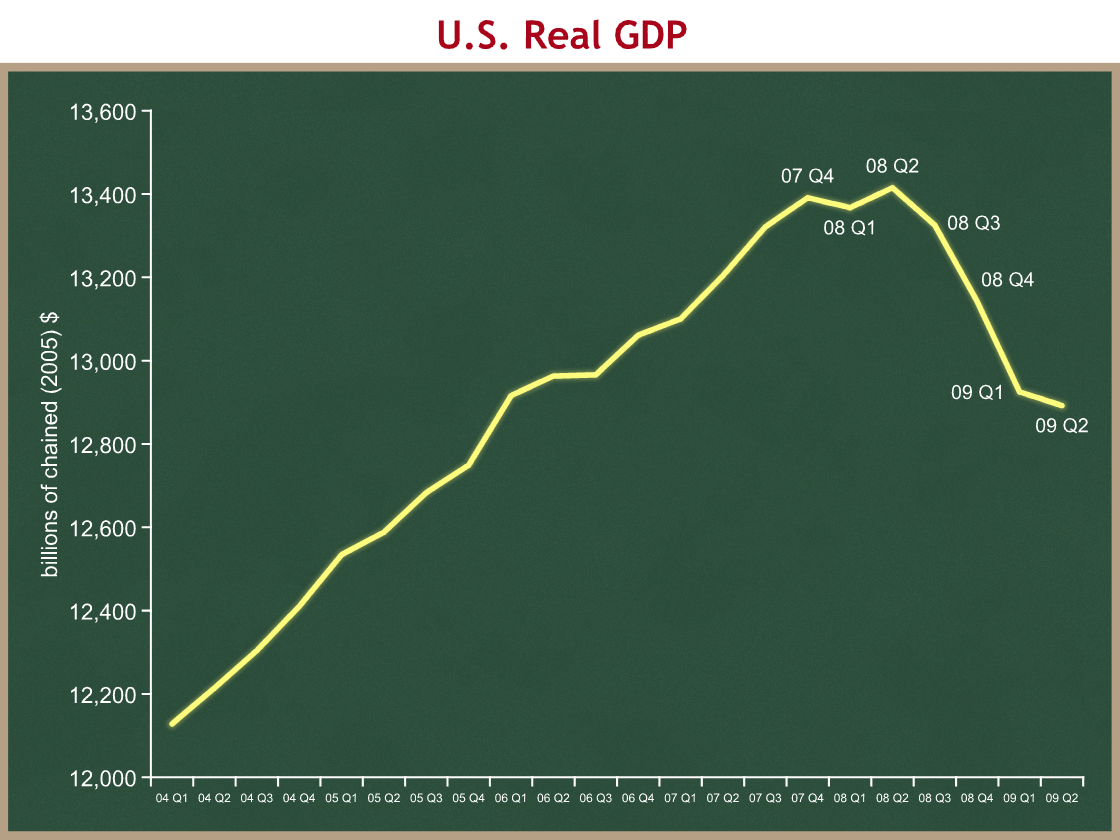
First let’s look at how things have changed over time. We can learn a lot from a simple picture. As always, you can click on any graph to see a bigger version.
US real GDP

The National Bureau of Economic Research (NBER) is the body that officially defines when recessions begin and end. Technically, they pick points that represent “peaks” and “troughs,” and then the recession is the time between a peak and a trough. NBER said that the peak was in the fourth quarter of 2007, so we say that’s when the recession began.

What jumps out at me from this graph is the difference between two parts of the recession. The graph bumps around between Q4 2007 and Q3 2008, then falls off a cliff. The press commentary (including from “sophisticated” analysts) talks about the recession that has lasted since the fourth quarter of 2007. While technically correct, that loses a tremendous amount of information. The severe recession, the one that has caused so much pain, really began in September 2008 when the financial crisis hit hardest. The current recession has been a mild recession for three quarters, interrupted by a severe financial shock which triggered three quarters (so far) of severe recession. Let’s hope today’s news means we are through the severe part and into a third phase.

It’s important to remember that the numbers you hear reported are growth rates. We learned today that U.S. GDP shrank 6.4% in the first quarter of this year, and another 1.0% in the second quarter. You can see how the line slopes downwardly sharply ending in the “09 Q1″ point – that downward slope is the 6.4%. The economy shrank in the second quarter, so the line is still going down. But it didn’t shrink as much, so the line isn’t sloped downwardly as sharply as over the past few quarters. That gentler downward slope is today’s -1.0%.

The business news channels are treating today’s -1.0% number as fairly good news, for two reasons. The recession is slowing down – we’re still going down, but not as rapidly. Everyone hopes that this signals that a “bottom” (on the graph) is coming soon, and that things will soon turn positive. In addition, the -1.0% is a little less worse than markets expected. The consensus market expectation was for -1.5%, so in this case the bad news is a little less worse than expected, and financial markets treat that as a good thing.

This fits with the President’s new language on the economy, used for the first time a few days ago. They have (finally) found their new tone on the economy, and I think they hit a sweet spot from a communications perspective:

So, we may be seeing the beginning of the end of the recession. But that’s little comfort if you’re one of the folks who have lost their job, and haven’t found another.

The first sentence is optimistic but cautious. The second sentence is compassionate. They have found language that allows the President to sound optimistic and look good if things gradually improve over the next few months, but that doesn’t get him in too much trouble if things go south, and doesn’t make him look out of touch with the painful employment picture. It’s not risk-free: if the jobs market data continues to get worse, he risks having looked too optimistic. This is one of the harder balancing acts for the President and his advisors.


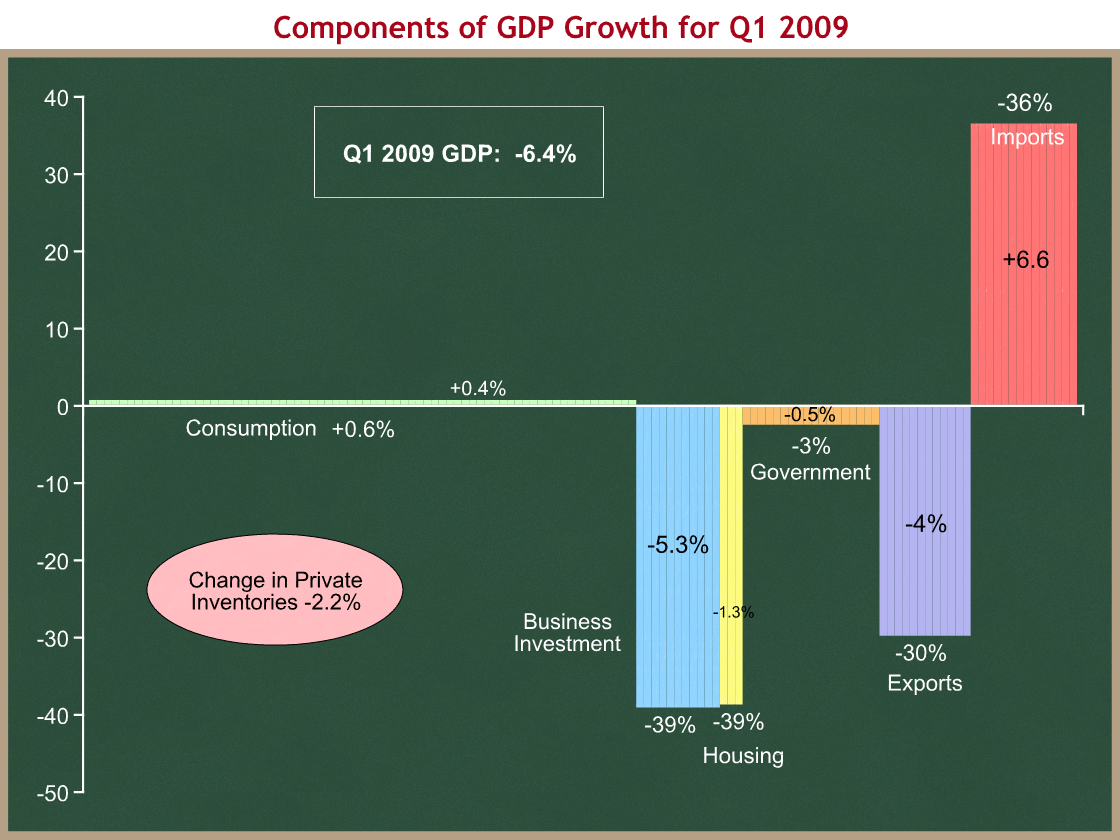
Let’s return to the numbers. For comparison we’ll begin by reviewing what happened in the first quarter of 2009. I have updated this graph to reflect today’s revisions to Q1 09 data.
components of GDP growth for Q1 2009 (revised)

We can see that in the first quarter:

  • The economy shrank at a 6.4% annual rate. This is revised downward from the previous estimate of -5.5%.
  • Consumption, which accounts for about 70% of the economy, was just above flat. It grew at a 0.6% rate, contributing 0.4 percentage points of growth.
  • Business investment and housing tanked, shrinking at a 39% rate. Combined they account for a -6.6% decline in the overall GDP growth rate.
  • Exports shrank, shrinking GDP, but imports shrank as well. Because imports subtract from GDP, the combination of the two was a net positive for overall growth.
  • Firms weren’t building up inventories, and that sucked out a lot. Government was a slight drag.

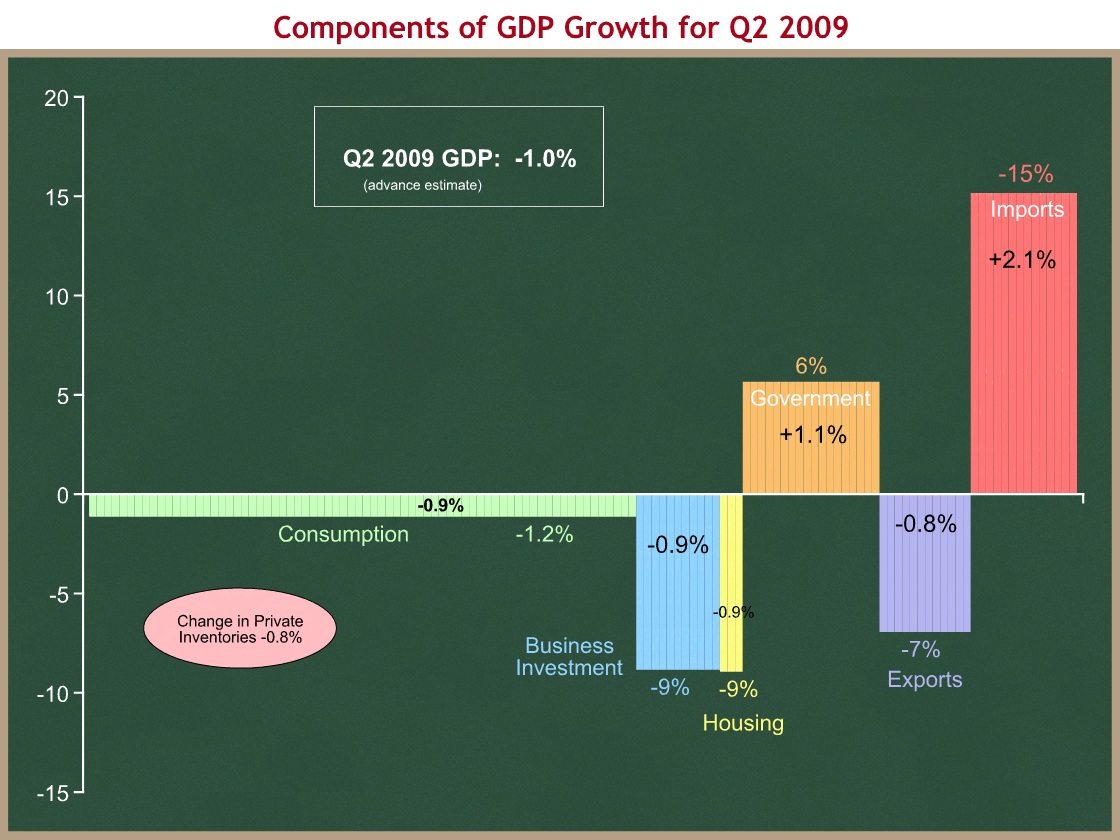
Now let’s look at what happened in the second quarter of this year. I think it’s most useful to compare the Q1 and Q2 graphs. You don’t even really have to look at the numbers – just the colors and heights of the columns should tell you a lot.
Components of GDP growth for Q2 2009

We can see that in the second quarter:

  • The economy shrank at a 1% annual rate.
  • Consumption shrank at a 0.9% annual rate, subtracting 1.2 percentage points of growth. UH-OH.
  • The huge change is in investment, both in businesses and housing. They’re still shrinking, but at a 9% annual rate, rather than the 39% annual rate from Q1. These two components knocked off 6.6 percentage points in Q1, and now they’re knocking off 1.8. That’s the biggest reason for the change, and it’s the big good news in this report.
  • The same is true for exports and imports. Exports shrank at a 7% rate in Q2 compared with 30% in Q1. Exports are still declining, but not as rapidly as they were.
  • Government spending is now contributing to GDP growth. There’s a fairly big swing from Q1 to Q2.
  • Inventories are being drawn down, but not as fast as they were in Q1.

The big change in government spending surprised me. Is the stimulus actually working that fast? It turns out that 60% of the growth from Q1 to Q2 is defense spending, so no. 25% is increased investment by State & local governments. It’s possible that some of that latter amount is higher because of anticipated stimulus funds from the feds, but I’d be surprised if much of it was.

Were it not for that -0.9% in consumption, this would be an across-the-board improvement from Q1. On CNBC this morning CEA Chair Dr. Christina Romer was asked about the decline in consumption, and she said there isn’t a huge difference between a +0.6% in Q1 and a -0.9% in Q2. I hope she’s right, but fear she may not be. That change may be statistical noise, but remember that our labor market is still incredibly weak. If people don’t have jobs, they aren’t getting paychecks, and they won’t spend much. We have to watch the labor market, not just the stock market.

Things to look for:

  • Jobs Day is a week from today, when we’ll see what happened to the labor market in July.
  • Sometime in August the Administration will release a revised economic forecast as part of the Mid-Session Review of the President’s Budget.
  • Dr. Romer said this morning that the Administration still expects positive GDP growth “in the second half of this year.”

16 Responses to “Understanding second quarter GDP”

  1. Imports…does this include oil? Either way, isn’t there a concern that the US (one of the largest, if not largest consumers in the world) is not buying stuff from other countries? Since the world is in a recession, and parts of the world are worse then us, then a large drop in imports like we see in the graphs could be a concern long term for Japan, China, etc.

    I see the same concern on the exports side. Other nations are not buying our stuff either. This cycle of less stuff being bought and less stuff being sold, can’t be a good omen.

    Maybe its more complicated then that? I’d love to hear what others think.

    Great site, Keith, keep it up.

  2. Mr. Hennessey: This is a wonderful explanation of the components of GDP, what the changes mean, etc. You could practically use this in a college classroom for instructional purposes.

    Suggestions (since you are looking for ways to improve your blog) to include some reference links (for those of us who have to see it for ourselves): Commerce Department report, NBER description of how the date recessions.

  3. Keith, thank you for a great article on the Q2 numbers. I do have a few questions though.

    With all of the focus on GDP growth as the primary measure of the health of the economy I think we fail to see the bigger trends that have developed. In some ways, using GDP as an aggregate measure of the health of the economy does not really tell us the whole story. Aggregates often do not tell us the real story. Here’s what I see:

    1.Government spending accounted for +1.1% in the GDP equation. When Government spends it either takes funds from the private sector via taxation, raises the funds in the debt markets or creates money out of thin air via the Fed. None of these methods are healthy and the first two actually reduce the amount of capital available for gross private investment (GPI).
    2. While the slowing of the rate of decline in business investment (GPI of negative 39% in Q1 vs. negative 9% in Q2) is good it does not indicate recovery. In fact, as capital becomes more and more ill-treated here in the U.S., the prospects for significant growth and prosperity are vastly reduced in the future.
    3. The decline in consumption is actually good not bad. For example, if the public continues to spend all they earn, where will the savings come from to fund future business investment and how will they pay for their retirement or emergencies in the future. This behavior directly impacts the future prospects for economic growth and the size of future budget deficits. As the deficits grow due to increased expenditires and falling national incomes to tax, the U.S. Treasury’s ability to continually raise new funds by selling additional debt will begin to be seriously questioned by the foreign buyers we depend on to finance our growing shortfalls. This will eventually have a shock effect on the currency.
    4. I believe we have huge structural defects in our current economic and government spending and financing systems that are not being addressed and will not be addressed until the next crisis occurs due to the political realities. I also believe there will large commercial real estate loan write-downs in Q4 and also another large amount of prime and ALt-A mortgage losses/foreclosures beginning later this year and picking up steam in 2010 and 2011.

    I believe all of these issues are being ignored by the pundits and analysts who are now cheerleading the “recovery.”

    I enjoyed your summary as it highlights the Q2 numbers well but I also believe there are some dark clouds ahead with our economy, the national debt level and the currency, including the possibility of high inflation, that needs to be considered.

  4. @Susanne Trimbath, Ph.D. – Excellent suggestion. I have edited the post to link both to the Commerce Department report, and to the NBER Business Cycle Dating Committee’s memo.

  5. Couple of minor corrections suggested:
    the Q2 chart shows the housing sector down 9% and its contribution to the overall number as 0.9% which matches the 0.9% contribution of business investment which is much larger. I believe the contribution to oveall GDP for housing is closer to 0.3%. If I’m correct, this also needs correction in the comments under the graph.

    The comment under the Q2 graph about consumption should have the numbers reversed to show a 1.2% drop in consumption and it’s contribution to the oveall GDP of 0.9%.

    None of this changes the overall message, but nice to clean it up.

    Thanks for the analysis of the GDP numbers and making it easier for the rest of us to understand the moving parts.
    -KJM

  6. Modification to my above comments. The contribution of housing to overall GDP is right, but the housing number decline itself is bigger ~29%.

  7. Keeping the Y-axis scale the same on both graphs would better facilitate visual comparison, as would placing Q1 and Q2 side-by-side.

    The export/import picture is terrible—don’t we usually look for increased trade as a solid indicator of true recovery?

  8. Nice disaggregation of the data, with an interesting explanation. How might one go about linking these movements with what is happening in the labor markets?
    Also shows the importance of external trade flows. How will these evolve in the near term as the major economies abroad move?

  9. Excellent breakdown of the data. Your analysis is both clearer and more detailed than any other source I use (WSJ, Barrons and Economist). That is an astonishing accomplishment for an individual blogger! Thank you!

  10. Interesting. Perhaps the only item I would add is that this summer’s bottom (and second quarter numbers) was not unanticipated. Before the stimulus Nick Bloom of Stanford (in January) projected, in his model, a mid summer bottom and a sharp V shaped recovery. And I think Ray Fair’s January model did the same.

    I happen to think that the recovery will be V shaped as most recoveries are when following a drop-off as we had in the first quarter. And I still think it won’t be till 2010 we see government spending really impact the economy. In Fair’s model it adds about 3/4 percent to the growth rate of 2010.

  11. “1.Government spending accounted for +1.1% in the GDP equation. When Government spends it either takes funds from the private sector via taxation, raises the funds in the debt markets or creates money out of thin air via the Fed. None of these methods are healthy and the first two actually reduce the amount of capital available for gross private investment (GPI).”

    You are referring to “crowding out,” which even Keynes would agree is a legitimate phenomena.

    “3. The decline in consumption is actually good not bad. For example, if the public continues to spend all they earn, where will the savings come from to fund future business investment and how will they pay for their retirement or emergencies in the future. This behavior directly impacts the future prospects for economic growth and the size of future budget deficits. As the deficits grow due to increased expenditires and falling national incomes to tax, the U.S. Treasury’s ability to continually raise new funds by selling additional debt will begin to be seriously questioned by the foreign buyers we depend on to finance our growing shortfalls. This will eventually have a shock effect on the currency.”

    This is only partially correct. Reduced consumption cuts growth, which is BAD. In the long run, we may not want so much consumption (70% of GDP or so) but in the short run, it is necessary and desirable to stimulate output. That’s why the government is creating inflation–savings are good in the long run but the paradox of thrift puts serious downward pressure on GDP.

    The only way we can have real “savings” anyway is if our government runs a surplus budget for a very long time. We have no savings….it’s been long since spent!

  12. Oh and I’ll add that I suspect the revised numbers will put the annualized, seasonally-adjusted, chain-weighted GDP for Q2 at a much larger contraction than -1%, but we will not know that for at least another month.

  13. Consider the federal debt to GDP ratio.

    The Investopedia says, “The debt-to-GDP ratio indicates the country’s ability to pay back its debt.” This ratio often is quoted in stories predicting the demise of America if federal debt continues to rise and especially if the debt ever were to exceed GDP. This ratio is so important, the European Union once required, as a condition of membership, the ratio of gross government debt to GDP not to exceed 60% at the end of the preceding fiscal year.

    But, how meaningful really is the federal debt-to-GDP ratio?. In August, 1971, we finally divorced from the last vestiges of the gold standard, giving the U.S. government the unlimited power to create money with which to service its debt. GDP has no affect on that. Even with zero GDP, the federal government could create unlimited money to pay its debts.

    Ah, but doesn’t “printing money” cause inflation? Apparently not. In the past 50 years, every spike in debt growth has corresponded with a decrease in inflation. One reason for this counter-intuitive lack of expected correlation between inflation and money supply: Inflation has been affected more by the supply and demand for oil than by the supply and demand for money.

    Further, GDP is production-based, while inflation is consumption based–two significantly different measures. So in the Debt/GDP fraction, neither the numerator nor the denominator refers to inflation.

    And as for that artificial 30%-70% range, consider these ratios: Japan’s debt is 170% of its GDP. Italy’s is 100%. “Wealthy” Russia’s debt is only 6% of GDP. The U.S. is above 60% and growing. What does it all mean?

    It means the oft-quoted Debt/GDP bogeyman reveals nothing, explains nothing and predicts nothing. It is the classic apples/oranges comparison, effective only at scaring politicians and voters into making the wrong economic decisions.

    About the only meaningful statement one could make about federal debt vs. GDP is this: ll nine recessions in the past 50 years, have been preceded by reductions in debt growth.

    Rodger Malcolm Mitchell
    rmmadvertising@yahoo.com
    http://www.rodgermitchell.com

  14. Excellent work, thank you.

    Tom

  15. Hi, mi name is mariela, in the article said taht : " Real GDP shrank at a 1.0 percent annual rate in the second quarter of this year, It means that it shrank at a rate that, if extended through a whole year, would cause the economy to shrink 1% over the course of that full year".My question is: How I get to have quarter rate instead of the annual rate?, thanks very much for your time.

    Mariela

  16. i tried to calculated annualized 1Q GDP manually and keep getting the same -6.59% number not -6.4%. Where am I doing wrong?

Follow

Get every new post delivered to your Inbox.

Join 5,644 other followers