
Responding to the President’s op-ed

I would like to respond to the President’s Washington Post op-ed, “Rebuilding Something Better.”  All quotes in this post are from the President.

Nearly six months ago, my administration took office amid the most severe economic downturn since the Great Depression.

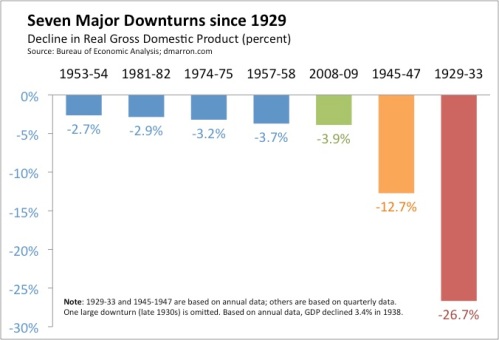
The President and his team use this language to lower the bar against which they are measured.  The U.S. economy was quite unhealthy on January 20th, and it still is.  Still, Donald Marron shows that, while the President’s statement is almost technically true, there is a big difference between “most severe … since the Great Depression” and “comparable to the Great Depression.”  Here is Donald’s graph:
image

You can see that the recession of the past 19 months is not comparable to the Great Depression.

Nearly six months ago, my administration took office … and many feared that our financial system was on the verge of collapse.

Incorrect.  In September-December of 2008, many feared that our financial system was on the verge of collapse.  Large financial institutions were failing roughly every other week.  By January 20th, we were pretty much out of the woods in avoiding a financial crash.  Things were still bad and needed serious long-term repair, but that’s not the same as on the verge of collapse.  Had our financial system been on the verge of collapse in January, we (the Bush team) would not have waited to draw down the last $350 B of TARP funding.

The swift and aggressive action we took in those first few months has helped pull our financial system and our economy back from the brink.

The President uses the past tense:  “has helped.”  Which actions, exactly, have had positive effects so far?

The Administration and the Fed deserve credit for the stress tests, which have encouraged banks to raise private capital.  And they have continued the Bush Administration’s efforts to prevent particular too-big-to-fail financial institutions (AIG, Citi, Fannie & Freddie) from imploding.

They successfully followed the path (which President Bush laid in late December) to allow GM and Chrysler to enter and exit bankruptcy, although they did it in a much more heavy-handed way than we had hoped.  President Bush’s and President Obama’s actions allowed these firms to avoid immediate liquidation, but it is too soon to call this effort a success.

That’s pretty much it so far:

  • The stimulus has not yet had any measurable macroeconomic benefit, although it will, starting a few months from now.
  • The much-hyped TARP “Financial Stability” program to buy risky assets (aka “the Public-Private Investment Partnership,” or PPIP) has been dialed back to a fraction of its originally proposed extent.  The specifics were announced only last week.
  • As of June 17th, CBO could find no evidence that any of the $50 billion allocated for foreclosure mitigation had been spent.  (See footnote (d) on page 2.)
  • The President’s announced small business loan program does not yet exist.
  • The President’s budget would make our fiscal position much worse than current law, necessitating both higher taxes and more debt over the next decade.  And, other than the stimulus and a huge appropriations bill, none of it has yet been enacted into law.
  • Creeping Congressional and Administration protectionist actions are filling the gap left by Presidential inaction on the free trade agreements with Colombia, South Korea, and Panama.

Aside from the important and apparently successful stress tests for which the Administration and the Fed rightly deserve credit, the most successful and effective actions taken by the Obama Administration in its first six months were the continuation of the TARP capital purchase program and the extension of the auto loans.  Both were initiated by President Bush.

I cannot see what else counts as as “swift and aggressive action” that “we [the Obama Administration] took in those first few months” that “has helped pull our financial system and our economy back from the brink.”

The American Recovery and Reinvestment Act was not expected to restore the economy to full health on its own but to provide the boost necessary to stop the free fall.  So far, it has done that.

2.6 million fewer Americans are employed now than when the President took office, and the unemployment rate is 9.5% and climbing.  Job loss in June was greater than in May.  The good scenario is one in which we continue to lose jobs for “only” another six months.  Please prove that the stimulus is working.  To use the Administration’s misleading metric, how many jobs have been “saved or created” so far?

It was, from the start, a two-year program, and it will steadily save and create jobs as it ramps up over this summer and fall.

Uh-oh.  Why are the verbs now in the future tense?   And what happened to the specific and oft-repeated prediction of 3.5 million jobs by the end of next year?  Those are important language changes, along with the implicit admission that the stimulus has not yet “ramped up.”

This did not have to be a two-year program.  Congress could have front-loaded the stimulus had they instead given the cash directly to the American people, as they did on a bipartisan basis in early 2008.  We would have saved much of it, paying off our mortgages, student loans, and credit cards (which would not be a bad thing).  We would have spent the rest much more quickly than the federal and state government bureaucracies now stumbling through their usual corrupt, slow and inefficient processes.  Instead the President handed the money and program design over to a Congress of his own party, who saw it as a big honey pot rather than as an exercise in macroeconomic fiscal policy.  The President’s primary macroeconomic policy mistake was allowing Congress to pervert a rapid Keynesian stimulus into a slow-spending interest-based binge.

The President is correct that the stimulus will increase economic growth, mostly next year.  That is too late, and later than it could have been had they done it right.

We must let [the stimulus] work the way it’s supposed to, with the understanding that in any recession, unemployment tends to recover more slowly than other measures of economic activity.  …  There are some who say we must wait to meet our greatest challenges.  They favor an incremental approach or believe that doing nothing is somehow an answer.

So the President says we must wait for the stimulus to work, then attacks others who say we must wait “to meet our greatest challenges.”

Who says we must wait?  Who favors an incremental approach to our greatest challenges, or believes that doing nothing is somehow an answer?  These are straw men.  I, for one, want to address these problems, but in a different way.  In some cases the solutions being developed by Congress would do more harm than good.  This does not need to be a choice between doing something and doing nothing, or between action and inaction.  If the majority party would allow the minority to have votes on their policy proposals, this would instead be a debate among different models for reform.

Speaker Pelosi told the President’s team privately that we must not address Social Security reform.  Our greatest immediate fiscal challenge is actually the rapid aging of the population, not health costs.  This is notably absent from the President’s problem definition.  We need to bend the health cost curve down and we need to address more immediate demographic pressures in Social Security, Medicare, and Medicaid.  The Speaker says we must wait to address the Social Security challenge.  She favors inaction.

To build that [stronger] foundation, we must lower the health-care costs that are driving us into debt, create the jobs of the future within our borders, give our workers the skills and training they need to compete for those jobs, and make the tough choices necessary to bring down our deficit in the long run.

Amen.  But …

  • The health reform bills being developed by a Democratic Congress would raise private and public health care costs and drive us even deeper into debt.
  • Raising energy prices will hurt the economy, not help it.  One could argue that the environmental benefit from reducing U.S. carbon emissions is worth it (I would not), but it is invalid to claim that higher energy prices will help our economy.
  • CBO says the President’s budget would result in deficits averaging 5.2% over the next decade, and would increase debt held by the public from 52% of GDP this year to 80% by 2019.  In the long run, we need to address immediate demographic pressures (which the Administration ignores) and change incentives to bend the long-term health cost curve down (which neither the President nor his Congressional allies have proposed).
  • If we do not, then “make the tough choices necessary to bring down our deficit in the long run” just means “raise taxes.”

Already we’re making progress on health-care reform that controls costs while ensuring choice and quality, …

Maybe the President knows about a bill that has not yet been released.  Every bill that is public so far would reduce incentives for individuals to consider the costs of the insurance they buy and the medical care they use, and would therefore increase health care costs.  These bills bend the private and public sector health cost curves up, not down.

On “ensuring choice,” CBO estimates about 10 million people who under current law would be covered through an employer’s plan would under the Kennedy-Dodd bill not have access to that coverage because some employers would choose not to offer it.  This breaks the President’s promise that “If you like your health plan, you will be able to keep your health care plan, period.  No one will take it away, no matter what.”

Already we’re making progress on … energy legislation that will make clean energy the profitable kind of energy, leading to whole new industries and jobs that cannot be outsourced.

Yes, but at a cost to the economy as a whole.  The House-passed bill would make clean energy profitable by raising the cost of carbon-based energy sources, which hurts economic growth.  In addition, American manufacturers will have to pay higher energy prices that it appears their Chinese and Indian competitors will not.  This hurts American firms and American workers.

I remain confused as to why the President believes he can claim that jobs in low-carbon energy technologies “cannot be outsourced.”  Of course they can.  The maintenance jobs cannot be outsourced, but design and manufacturing of clean energy technologies can be done anywhere in the world.

We must continue to clean up the wreckage of this recession, …

Lucky for us we have an economy that self-repairs over time.  Economic growth will at some point return, with or without good policy.  In the case of the financial sector, the capital purchase program and stress tests are accelerating the pace of recovery.  In most all other cases, the President’s policies cannot be demonstrated to be helping.  GDP continues to decline, and the anticipated good scenario is one in which job growth does not return until early next year.  When you combine these uncomfortable facts with statements like “we misread the economy” and “we had incomplete information,” it is hard to see how the clean-up claim is justified.


After a rough ten days economically and politically, the President is trying to regain his footing and frame the week ahead.


The new jobs data has caused him to back off his specific commitment — there is no longer any mention of 3.5 million jobs by the end of next year.  But the primary point of this op-ed is to signal a new message, captured most succinctly here:

[The stimulus] was expected to provide the boost necessary to stop the free fall.  So far, it has done that.  It was, from the start, a two-year program, and it will steadily save and create jobs as it ramps up over the summer and fall.  We must let it work the way it’s supposed to, with the understanding that in any recession, unemployment tends to recover more slowly than other measures of economic activity.

The President’s new message is:  No second stimulus.  This one will work.  Ride it out and be patient.

He’s right that it will help, eventually.  If the July employment report due on August 7th returns us to the prior slow but steady recovery path, the President might only have to worry about 6-9 months of economic and political pain.  But if the July report shows that the June report is a new downward trend, then policymakers will have a more serious problem to address.

The President’s op-ed is titled “Rebuilding Something Better.”  Unfortunately I think there is a roadside construction sign reading “Expect lengthy delays.”  Let us hope it doesn’t take too long for the rebuilding to work.

(photo credit: Sewer Construction at Commercial and Broadway I by roland)


Related Posts

(best matches are listed first)
  1. Six month economic policy status update
  2. What can President Obama learn from President Bush’s bipartisan successes?
  3. Many mixed signals
  4. The President’s new stimulus proposal
  5. Address by President Bush on financial markets
  6. Responding to the Vice President’s op-ed
  7. President Bush’s speech on financial markets and the world economy
  8. 20 questions for the President’s press conference
Twitter Digg Delicious Stumbleupon Technorati Facebook Email

This website uses IntenseDebate comments, but they are not currently loaded because either your browser doesn't support JavaScript, or they didn't load fast enough.

95 Responses to “Responding to the President’s op-ed”

  1. These are my replies to Brian N and Paul:

    >>>>Brian N said:
    I hate to rehash, but David said:

    “Reading all of these one-sided comments (ok, I only read the first 10, after which I became bored) makes me wonder: does this blog simply preach to the choir? And if so, whats the point?

    I would reply: I guess he never reads Huffington or Koz. If so, it kinda makes the question look silly.

    >>David’s reply: You’re right, I’ve only read those blogs a couple of times and I found them equally ridiculous. But saying that “the liberals are doing it too” is not an effective defense of the Hennessey blog’s merits.

    >>>>Brian N said:
    [Quoting from David] “Some of your analysis was well thought out, but much of it is nitpicking. Tell me one thing – does Obama ever say anything that you agree with? Such knee-jerk animosity to every… little… thing the president says hurts your credibility as an analyst.”

    I would reply: Where were you in the prior 8 years? All I ever read is substantive arguments against POLICY and all I hear is the above silly refrain. Would you like that with a dose of venom and hate? That was the prior 8 years. Now there are arguments about policy and NOT hate, yet people have to put up with THAT as a “thought process.” (Puke.)

    >>David’s reply: My opinion is that both parties are similarly culpable for playing the blame game when the other party is in power. To give just one counterexample, were the Swift Boat attacks arguments against a policy, or were they personal attacks that played on people’s fears (a common technique used by everyone in politics, regardless of party)? Just like many Democrats need to come to terms with the bitterness they’ve harbored for the past eight years, conservatives need to take a deep breath and reflect “are we just being sore losers (at least a little bit)?”

    For example, a few comments on this blog make strong sarcastic remarks about Obama being the “13th Apostle”, “Dear Leader”, “Thug-o-nomics”, “illegal alien” and other indefensible jabs. Using this type of language makes the writers seem bitter, nasty, and out to hold a grudge. True, there are many people that adore “the 13th Apostle” Obama, but just as many conservatives adore Reagan, even today. In the end, it’s all a wash; the sniping and resentment from both parties has become unbearable and even juvenile, in my mind. (“An eye for an eye leaves the entire world blind,” and so on…)

    Now, I don’t mean to say that I am above the fray. Although I try to be balanced, I have my own biases and am reminded every once in a while to “tone it down.” My belief is that other people can do the same.

    >>>>Brian N said:
    [Quoting David] “So what do we, the public, actually gain from reading such one-sided (dare I say mob-like) commentary? Nothing. Seems to me that this blog is just a venue for narcissistic chatter that leads us nowhere constructive.”

    I would reply: THANK YOU!!! I have not yet heard a better argument against the mainstream press. Brilliant, even if you thought you meant something else!

    >>David’s reply: I’m very glad to hear that; thank you as well. I meant it just as you construed it.

    >>>>Paul said: David, do you disagree specifically with any of the analysis? What data supports your viewpoint? I am interested to hear a data driven argument in favor of the president’s policies.

    P.S. The average sophistication of comments here is about 10x higher than you would find in the NYT, for example.

    >>David’s reply: I’ll give one example of how Hennessey is nitpicking:

    Hennessey says: While the President’s statement [that his administration took office amid the most severe economic downturn since the Great Depression] is almost technically true, there is a big difference between “most severe … since the Great Depression” and “comparable to the Great Depression.”

    Fine. Score one for Hennessey, but so what? Why is the author so peeved about Obama’s semantics. Can we just agree that “the current economic situation sucks, so let’s do something to fix it.” Hennessey sounds like the boy who cried wolf: by crying foul at just about everything Obama says, Hennessey dilutes any legitimate points he might have. The result of this nitpicking is more anger and more resentment directed at the president based not on policy but word choice. This kind of “analysis” is just tired.

    To all: I’d be happy to hear if you agree/disagree with what I’ve said.

  2. David,

    As both a conservative and an early follower of Mr. Hennessey’s blog I can say positively he frequently goes out of his way to credit the President when he agrees with him and can generate equal disagreement from conservatives as he does from more liberal followers of the blog. I think Mr. Hennessey focuses on semantics because his experience in the Bush Administration in addition to his history on Capitol Hill, he knows the importance of word choice and parsing those choices frequently leads to a greater understanding of the underlying thinking of the Administration. He provides analysis based on his knowledge of how things work, or the “inside baseball” and parses the political language which I think is a huge advantage for those who want to understand where the Administration may be going with a variety of issues. I think if you read all of the previous posts you would see how this analysis generates insight.

  3. I’m certainly glad we agree on the press. But we should be able to slug it out in forums such as this, and the “journalists” should either take the center road or hate both parties equally. I believe that is the worst thing about our current predicament. Our forefathers predicted much, but I don’t think they ever envisioned the press going missing in action.

    Thank you for your thoughtful reply! There isn’t enough of that around here. In fact, I have my own biases and am reminded every once in a while to “tone it down.”

  4. David –

    Thanks for your comment. I try to compliment the President and the Administration when they say things I support, and critique them when they say things I oppose. I have a different perspective on policy, so I hope it does not surprise you that I often find things to critique.

    And yes, I will write a lot about small snippets of what the President or his senior advisors say. Having been on the other side, I know how important those words are, and I know how carefully they are chosen. When the subject matter is this important, a single sentence or argument can have an enormous impact on people’s lives. I believe it’s worth my time to explain, analyze, and sometimes critique those words. I hope that others, including you, find it useful.

    Most importantly, I try to keep this about the policy, rather than the people. I hope you will keep reading and that you will critique me when you disagree with the substance of my posts.

    To demonstrate that my content is not all one-sided against the President (and thanks to Mary M for sticking up for me),

    please see here: Kudos to the President for proposing to scale back terrorism insurance, in which I write

    and parts of this: Director Orszag’s 10th year test…, in which I write, “Director Orszag is correct … Director Orszag therefore deserves credit … I commend Director Orszag for setting forth this new test …”

    and this: The President’s strong free trade language in Strasbourg, in which I write, “I would like to compliment and thank President Obama for saying this in Strasbourg, France last Friday.”

    and this: Parsing the President’s health care reform letter, in which I write, “This is fantastic, especially as paragraph #2. … This is fantastic and unexpected from a Democrat. … The President’s letter correctly identifies the problem to be solved as health cost growth …”

    and this: Six month economic policy status update, in which I write, “Good: The bank stress tests worked … the TALF is working … There has not been a sudden failure of a major financial institution since the President took office … As a result, the severe instability that plagued inter-bank lending markets and certain credit markets last fall and winter has largely receded.”

    Thanks for reading, and for your comments.

  5. David –

    I would also like to respond on the “most severe since the Great Depression” point. This is a rhetorical flourish by the President and his team that has a significant policy and political impact. I think it is valuable for readers to understand why I think he chose that language “since” rather than alternate language “comparable to”. I think it is important for people to understand the numbers that allow the Administration to say this and be (almost) technically correct, but which still convey what I believe to be an incomplete and misleading picture. And I think it is important for people to understand the political/communications strategy that I think is behind it (lowering the bar against which he and his Administration will be measured).

    I also have a personal interest, because the President’s word choice frames the work I did for my old boss in the worst possible light. I am happy to admit that I have that personal perspective that further motivates me to explain this particular point.

    I believe all of these are salient points for those who want to better understand economic policy and the politics, communications, and strategy that goes into making it. If that level of detail does not interest you, or if it seems like nitpicking, then we can agree to disagree. I still hope you will continue reading.

  6. Jeffrey B. 14 July at 10:05 pm

    President Obama:

    “Nearly six months ago, my administration took office amid the most severe economic downturn since the Great Depression”

    Wasn’t it Vice President Biden who just said that the administration underestimated the severity of the economic downturn? How is it possible to underestimate the severity and then have your boss characterize the downturn as the worst since the Great Depression?

    Finally, so many inconsistencies of President Obama’s statements are pointed out by kbh that it makes one wonder why the media/press won’t ask these questions. Why are the questions found in blogs and not posed by reporters?

  7. @Tim

    As of today Georgia has the highest unemployment since guess when??
    Obamanoics 101: load the economy with so much to do and the reaction is… economic collapse.
    I have always said that the closest thing to the Communist Party has always been the Democratic Party. I hate to be proven right.
    The Republican Party has been getting much like the Dems. In the last administration it seemed like they were trying to outspend the Dems. President Bush was not a good choice BUT at the time he was the ONLY choice. With the likes of AlGore (global warming creep) or Kerry (find him a multimillionaire heiress and he will do anything to marry her) we would be in the position that we are in now a long time ago.
    BTW I have downloaded all 98 pages of the “NCEE Comments on Draft TED Endagerment Analysis for GHC Emissions under CAA”. You know the refuting of the “global warming” that the EPA wanted to hide. Basic to it is that there is no real science that can definitively say that the human population has little to do with the global warming the sky is falling so we have to tax YOU all to death crowd.
    China and India to point out a couple of rogue countries: have said that they will never do the Cap and Trade thing. It is all about the monies and the power.

  8. JF of Los Angeles, cA 16 July at 3:51 am

    Just found this blog. Wow, this place is crawling with the black helicopter crowd–still going on about the President not being a citizen, puhleeze silly little rabbits, you people, thank God, will be politically extinct soon. There is simply no place in informed civic discourse for the delusional and petty-minded.