
Understanding first quarter GDP
Last Wednesday the Commerce Department released their final data for first quarter (Q1) U.S. GDP. GDP shrank at a 5.5 percent annual rate in the first quarter of this year. (This takes inflation out of the calculations, so we’re measuring the growth of real GDP.) That doesn’t mean it shrank 5.5% that quarter. It means that it shrank at a rate that, if extended through a whole year, would cause GDP to shrink 5.5% over the course of that year. If the economy is performing well, it’s growing a little faster than 3% per year. We were more than eight percentage points below that in the first quarter of this year.
I find it useful to understand how the major components of GDP are performing. The graph below allows us to do that. I created this format while in the White House for my own use, and now I’d like to share it with you. Please bear with me – there’s a lot of information in one graph, and it may take some getting used to. Here’s the summary:
- The width of each component bar represents its share of GDP.
- The height represents the growth rate of that component. This growth rate is labeled in white immediately above or below that bar.
- The black number within the bar shows that component’s contribution to the overall growth rate of –5.5%
- Private inventories and Imports require special explanation.
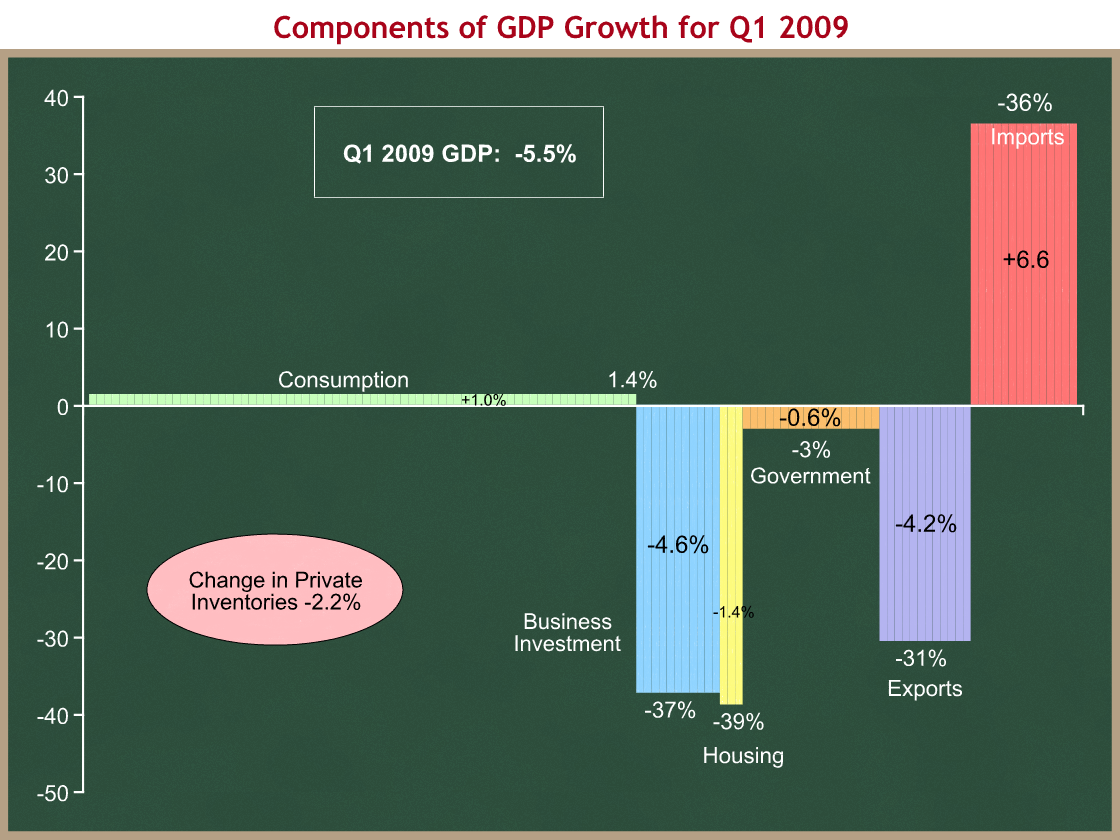
Consumption is the widest bar. People buying stuff to consume accounts for, on average, about 70% of GDP. Right now it’s 72%. This explains why economists and market forecasters care so much about measures of consumption. If consumption grows modestly, the economy will grow. You can see from this graph that consumption grew at a 1.4% rate in Q1. Multiply 1.4% by 72% of the economy, and you get +1.0 percentage points of GDP, the number in black within the green bar. Consumers contributed to a positive 1.0% annual growth rate, while the rest of the picture subtracted 6.5 percentage points, resulting in a net –5.5%.
The bottom fell out of both business investment and housing in Q1, shrinking at rates of 37% and 39% respectively. Those are disastrous numbers. Since business investment accounts for about 11% of GDP, and housing only about 3%, you can see that the decline in business investments took 4.6 percentage points off the aggregate growth rate, while housing knocked off another 1.4 percentage points. While everyone focuses on housing, we shouldn’t lose sight of the much larger effect of plummeting business investment.
Most of the world economy is shrinking. People in other countries don’t want to buy our stuff, so our exports plummeted at a 31% rate. Similarly, we’re not buying stuff from other countries, so our imports declined 36%. Because of the way GDP arithmetic works, a decline in imports adds to GDP growth. This is the one big flaw in this graph format – I put the imports bar in positive territory because it adds to GDP growth, but imports actually shrank. I’d appreciate suggestions on how to make this work better visually. The net effect is that the decline in exports was more than offset by the decline in imports, so the effect of net exports (exports – imports) actually contributed 2.4 percentage points to GDP growth in Q1.
The bad news is that inventory investment was negative, subtracting 2.2 percentage points to the overall growth rate. The good news is that the change in private inventories contribution tends to be cyclical. As inventories get drawn down, there eventually is a need to rebuild those inventories. So while other drags (like housing) could continue for a while, I would expect that the pink oval will eventually move back into positive territory.
The overall picture is for Q1 was, unsurprisingly, bleak. Were it not for the consumer still continuing to spend, things would have been even worse.
The stimulus law will effect this eventually by raising that orange bar, government spending, into positive territory. The tax code changes and expanded unemployment insurance benefits have a small positive effect on the green consumption bar.
I wrote on June 3rd that I thought the Obama Administration made a huge mistake in the way they designed the stimulus, even given the President’s policy preferences. They’re pushing most of the money out through the government channel, represented by the orange bar above. The problem is that these dollars spend out incredibly slowly, and so the orange bar won’t be boosted significantly until Q4 of this year (at the earliest).
They should have pumped all the money out to consumers. Consumers would have saved more than half of those funds, but given that it was a $787 B package, if consumers spent only one-third that amount, you would have seen an immediate and significant upward bump in the green bar, beginning at the end of Q2 (now), and into Q3 and Q4. Stimulating consumption results in only a portion of the dollars going to higher GDP growth, but it happens much more quickly than trying to force money out the door through government bureaucracies. By allowing their Democratic Congressional allies to funnel stimulus dollars through government programs, they unnecessarily delayed the bulk of the positive economic benefit until next year.
Let’s hope the Q2 numbers are less bad. We will see the first data in the last week of July. Whatever the results, they will be largely independent of the stimulus, which is having only a small positive effect even now. The scary scenario is the one where the labor market continues to decline, and that causes consumption to go negative before the other sectors have time to recover.


You need to note that those are reals and not nominals. Another feature of this decline in GDP is that nominal GDP also shrank. This is troubling for the following reason, debt is serviced out of nominal GDP.
They should have pumped all the money out to consumers
That’s GOP code for tax cuts, no.
The stimulus is $20 billion per month ending September 2009, $30 billion per month ending September 2010 and $12 billion per month ending September 2011. The pump priming seems reasonable to me.
Since you like charts. The initial CBO cost estimates are http://www.cbo.gov/ftpdocs/99xx/doc9968/hr1.pdf” rel=”nofollow”>here.
They’re pushing most of the money out through the government channel, represented by the orange bar above. Would you care to put that push in percentage terms. It seems to me that tax cuts exceed direct government spending.
You write above:
By allowing their Democratic Congressional allies to funnel stimulus dollars through government programs, they unnecessarily delayed the bulk of the positive economic benefit until next year.
Let’s assume this is correct. From a strictly political perspective, isn’t this a net positive for Obama? If the stimulus money only really starts to pick things up next year, doesn’t that mean that the stimulus will have its greatest positive effects for the midterm elections?
Great discussion and I like the chart. One top White House Advisor lays blame to a microwave society that wants too much from government too fast. Of course that is not literally what he said, but it is the same idea. Here is an excerpt from a Yahoo article, “White House adviser David Axelrod urged patience for President Barack Obama’s $787 billion economic stimulus package in the face of sliding poll numbers. Former Massachusetts Gov. Mitt Romney, a past and potentially future presidential candidate, said the spending was ill-designed and served only to expand the size of government.” While this is what the leadership is asking, patience, they sure have a number of other programs that they have been noting will fix things overnight (or it is how they are selling it to the public): healthcare, energy, banking, jobs, housing, etc. Maybe we should listen to Axelrod and know that these policies do take time, and many times that extra time is what causes excesses, inefficiencies, and distortions to the economy. Maybe we should practice what we preach!
@Joe P. –
This, Joe P., is one more reason why Obama is a brilliant (but despicable) politician. He has made several of these moves, using policy to advance his political power rather than using his political power to advance smart policy. For example, the more government handouts and entitlements he gives out (cap and trade allotments to utilities and manufacturing sectors, public health care plans, expanded unemployment benefits, bailouts and government loans to struggling corporations) the more people are reliant upon the government for their livelihood–such people are unlikely to vote for anyone who talks about eliminating such entitlements or handouts by shrinking government.
This is going to help him and other left-of-center elected officials, but unfortunately the American people will suffer for it. Kind of like a mild version of Hayek’s “Road to Serfdom.” The Democrats are like a less violent version of the “strong man.”
Keith,
Excellent presentation of the GDP. I hope you can do that each quarter. It brings perspective to this important measurement. Thank you!
They should have pumped all the money out to consumers
“That’s GOP code for tax cuts, no.” (Marmico)
Perhaps Marmico ought to look more closely at his chart – at least a third of the projected 2009 stimulus are tax cuts. Moreover, the recent macroeconomic literature suggests that tax cuts are a far more effective form of stimulus (with multipliers ranging as high as 3-5 times). Given recent findings, it is most likely that whatever stimulative effects that are being currently felt are due to the tax cuts.
Also, regardless of the CBO’s initial projection of spending, as far as I know the actual spending (not just distribution, BUT spending) amounts to several 10’s of billions. The classic problem, as taught in undergrad econ courses, is that fisical policy is supposed to be countercyclical, not pro cyclical. As the bulk of the spending will be late or very late (2010 and 2011) it will add create “higher highs” followed by lower lows. Most economists would consider this poor policy.
Finally, while we wait for mid-year updates by the CBO and the Administration, the most recent model I have examined (FAIR, from Ray Fair at Yale) shows that the stimulus should create around 3% growth in 2010 (1/2 to 3/4’s being from the stimulus, the remainder “natural”) followed by two years of weak growth (1.8%).
Once again I think Keith is correct. Early on the the Council of Economic Advisors recommended to Obama that he immediately spend the money to reimburse states who declare a sales tax holiday. That policy could have been implemented in late January, and the CEA were enthusiastic in their support (see Joe Klein Newsweek Article on Obama’s first days in office). Obama rejected that because he is enthralled with “investiment in infrastructure” and thought waiting two or three years to spend was better (mainly a subjective belief on his part).
I am not being partisan here – I’m just noting the facts and the literature. Had he spent 100% of the stimulus this year through tax cuts or holidays (like no personal income tax for one year) the economy would have rebounded.
Keith,
I’m an idiot. I am so used to being able to edit after posting that I left three reference paragraphs at the end of my last post. Pls delete for clariety – I will not do this again.
Mark H.