
How much bailout money will taxpayers get back?
The Congressional Budget Office (CBO) has released their assessment of the Office of Management and Budget’s semiannual TARP report. That assessment estimates how much cash has gone out the door for each part of TARP, and how much CBO expects will ultimately be returned to the Treasury. I have converted CBO’s table (Table 1 on page 2) to a set of graphs. Looking at the Capital Purchase Program (CPP) in the bottom bar, $199 B has gone out the door in outlays, and CBO expects $174 B of that will be paid back. CBO calculates a subsidy rate for each program, which for CPP is 25 ÷ (174 + 25) = 13%. Taxpayers should expect to recoup 87% of the funds that were invested on their behalf in the Capital Purchase Program and lose the other 13%.
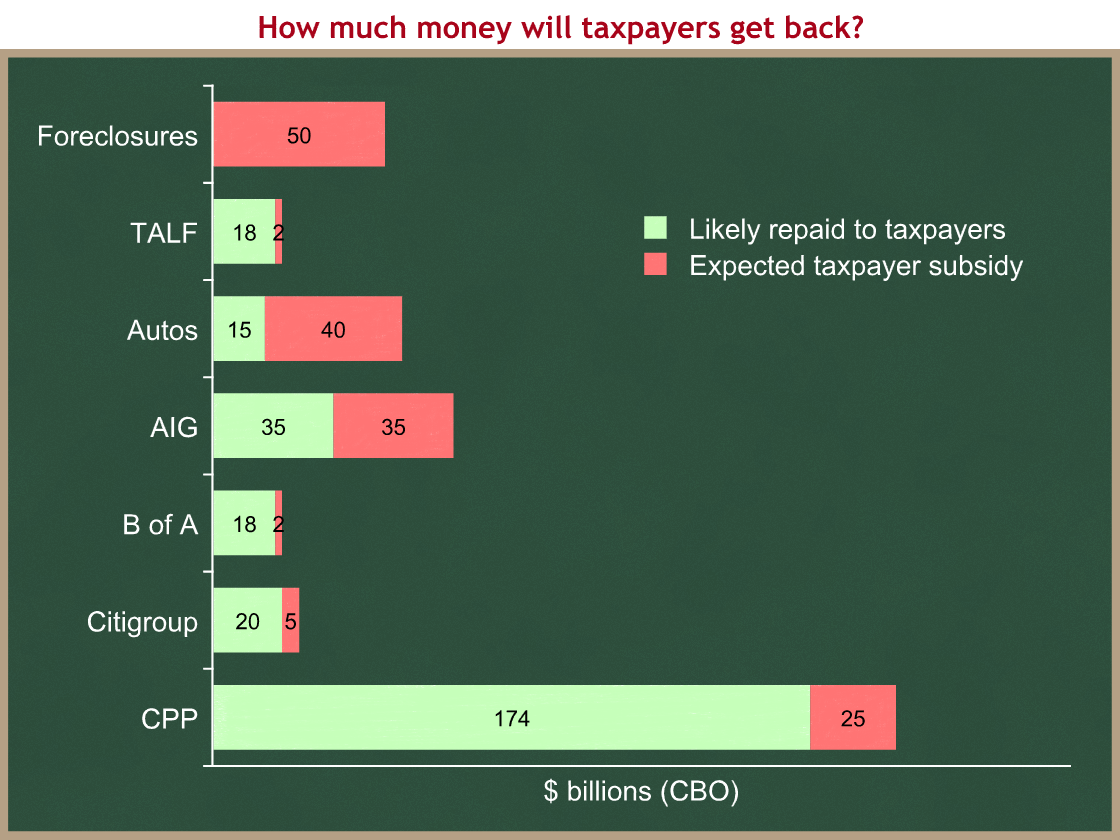
You can see from the graph that most of the funds went to capital purchase: CPP + specific firm deals (AIG, Bank of America, and Citigroup). CBO thinks we taxpayers will get most of our money back from Bank of America and Citigroup. We’ll get about half back from AIG, and a little more than a quarter back from the autos and auto finance companies. The Administration’s foreclosure mitigation program is a spending program, not an investment, and thus we expect to get none of those funds back. Footnote (d) on CBO’s table contains a surprise: “The Treasury has not yet disbursed any of the $15 billion allocated as of June 17, 2009, for foreclosure mitigation.” We heard a lot about the President’s efforts on foreclosure mitigation, and yet no cash has flowed.
To answer the question, “How much bailout money will taxpayers get back?” CBO estimates that:
- $439 B of the original $700 B has been spent;
- $280 B of that will be repaid; and
- $159 B will not be repaid and will be a cost to the taxpayer.
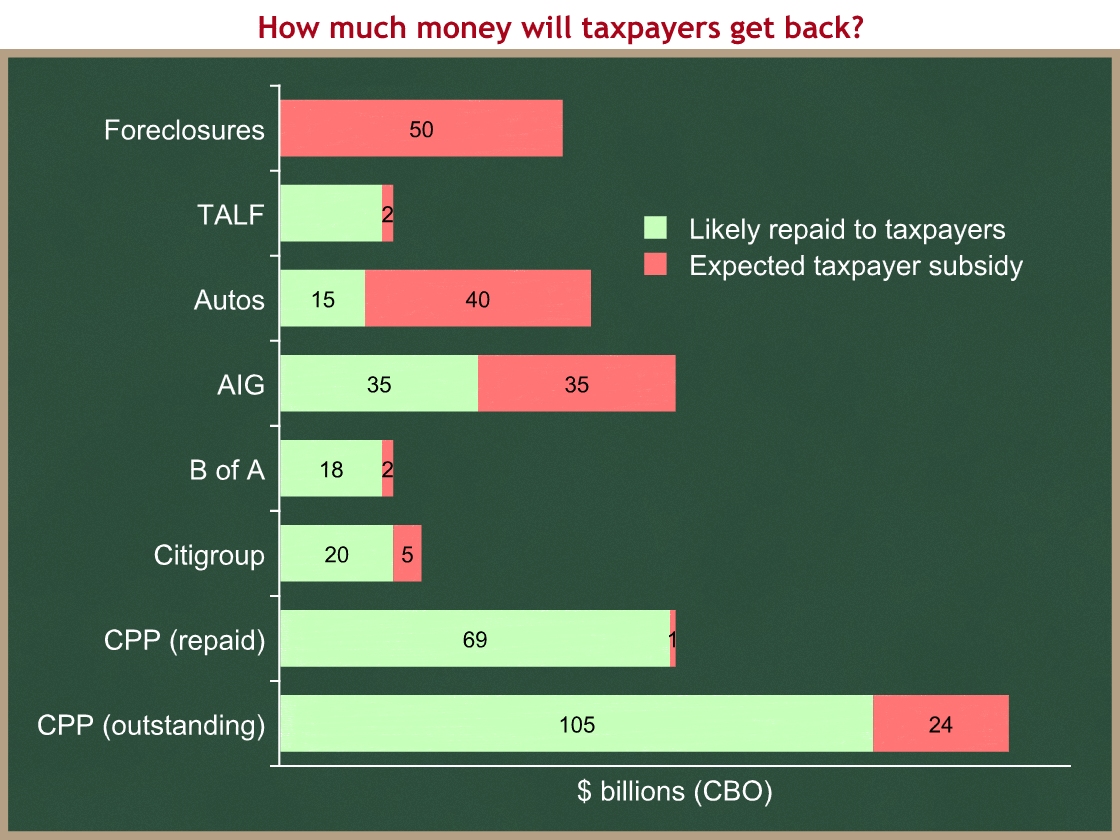
CBO provides further detail on the Capital Purchase program by subdividing it into two parts: CPP for the 32 banks that have already paid back the Treasury, and CPP for all the other banks. Here’s the same graph, but with CPP split into those two parts. You can see that the net cost to the taxpayers from the 32 banks that have already paid back Treasury was (only) $1 B. CBO is guessing a much higher loss on the remaining outstanding CPP investments.
We do not have similar estimates for all of the Fed actions, but we do for the FDIC’s actions, and for the bailout of Fannie Mae and Freddie Mac. The picture changes dramatically when we add these non-TARP financial rescue funds. Courtesy of Sen. Judd Gregg’s excellent Senate Budget Committee Republican staff, I’m going to add in orange the estimated taxpayer costs of FDIC’s component of the Citigroup rescue, and CBO’s estimate of the taxpayer cost of bailing out Fannie Mae and Freddie Mac.
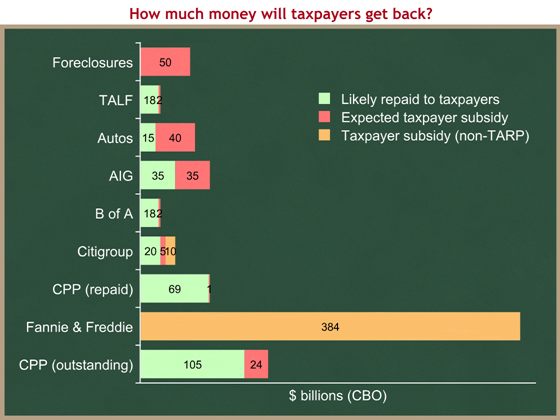
CBO estimates that the cost to the taxpayers of the failure of the GSE’s, Fannie Mae and Freddie Mac, will be $384 B. That is 2.4 times larger than all the other TARP and non-TARP costs (shown here, and excluding the Fed) combined. Here’s the Budget Committee Republican staff’s Budget Bulletin:
CBO estimated that the federal government immediately absorbed a loss of $248 billion for the book of business the GSEs had in September 2008. To maintain an active mortgage market, the federal government is continuing to operate the GSEs, whose new commitments entered into after September 2008 would lose an estimated $136 billion over the 2009-2019 period according to CBO.
Thus when we rank the expected cost to the taxpayers of the different TARP and non-TARP programs, we get:
- Fannie Mae & Freddie Mac ($384 B)
- Foreclosure mitigation ($50 B)
- Autos & auto finance ($40 B)
- AIG ($35 B)
- Outstanding equity investments in banks through the Capital Purchase Program ($24 B)
- Citigroup ($15 B)
- Bank of America ($2 B)
- The direct Treasury cost of the Fed’s liquidity facility ($2 B)
- Repaid equity investments in banks through the Capital Purchase Program ($1 B)
That $384 B number is huge.
And updating to include TARP + FDIC + GSEs (but not the Fed facilities), it appears CBO estimates the net cost to the taxpayer of all these non-Fed facilities will be about $553 B.
Thanks to Jim Hearn of Sen. Gregg’s Budget Committee staff for his incredible table and assistance.
Sources:
- CBO’s The Troubled Asset Relief Program: Report on Transactions through June 17, 2009
- Senate Budget Committee Republican Staff’s Budget Bulletin (June 25, 2009)
If you’re really into budget policy, you should keep your eye on the Budget Bulletin. You can subscribe by emailing their webmaster, whom you can find here.
Related Posts
(best matches are listed first)- Intro to TARP — TARP III: The Geithner Plan
- Is $700 billion enough? Part 3: Secretary Geithner says we have more room
- Six month economic policy status update
- Is $700 billion enough?
- Is $700 billion enough? Clearing up the confusion (or at least trying to)
- Four unpleasant options for TARP funding
- Is $700 billion enough? Part 2: the Obama warning
- What caused this financial mess?


Just a quick thought. If averting a loss of trillions in asset values on top of what we have already lost only carried a premium of about $550 billion that seems to be a bargain. My understanding is that a severe deflationary spiral would have taken hold, crushing asset values, absent the Fed’s and Treasury’s actions. BTW I was absolutely terrified last September of what a deflationary spiral would do to the assets backing my pension plan. I envisioned in the worst case a temporary reduction in monthly disbursements or even complete liquidation.
The question remains, of course, whether the capital markets will be able to absorb all the borrowing by the US treasury and other governments trying to stimulate their economies. If markets eventually buckle under the weight of all this borrowing, then we are merely in the eye of the storm and another round of turbulence is on its way.
D. Lawrence, Is the borrowing to which you refer the additional borrowing of the Obama admin? Is it the stimulus spending this year through 2012 and the permanent increase in spending from a new government entitlement? If it is then that is separate from the TARP and other direct investments. I was referring to just the spending on TARP, auto bailouts and guarantees to the GSEs. This spending is a one shot stimulus. Obama’s stimulus spending is also mostly a one time affair except for some reforms to unemployment insurance that generally falls on the states and employers. The permanent increase is in new healthcare entitlement spending.
Steven Hales:
If averting a loss of trillions in asset values on top of what we have already lost only carried a premium of about $550 billion that seems to be a bargain.
Huge, huge, “if”, right there. There is no evidence that TARP averted a loss of that magnitude — or, really, that it accomplished much of anything at the macro level.
My understanding is that a severe deflationary spiral would have taken hold, crushing asset values, absent the Fed’s and Treasury’s actions.
You are mistaken in your understanding. Paul Krugman certainly indulged in a great deal of fearmongering about deflationary spirals, but there was respectable economic opinion the other way, and what would have happened is unknowable.
“the net cost to the taxpayers from the 32 banks that have already paid back Treasury was (only) $1 B.”
How did it cost anything if it was paid back with whatever interest was due.
So Fannie and Freddie are 70% of the deal, yet the financial regulation reform package says nothing about them. Isn’t that curious?
DLawrence,
I think that your (and other people’s) fear of deflation is rooted in the Great Depression. That’s still our pattern for what we define as true economic crisis, so when things turn south, there’s a natural tendency to try to correlate what we see/fear to that. Really, though, I can’t see rapid deflation ever happening in this country again. The first time around was because of a gross mismanagement of the money supply by the Fed, a lesson that pretty much everyone has learned and will not repeat. In fact, since the 50’s, no quarter of GDP shrinkage has been accompanied by anything more than moderate deflation (.5%-2% per month), and from 1955 – March 2009, we didn’t even have a single MONTH of deflation. There’s a little bit of it going on right now (we experienced a -1.28% rate of inflation in May, apparently), but I don’t know that I can count that as the sign of a catastrophe after over 5 uninterrupted decades of inflation. (I got my numbers from here: http://inflationdata.com/inflation/Inflation_Rate/HistoricalInflation.aspx?dsInflation_currentPage=4).
Were I in your shoes, I’d be much more worried about the threat of inflation devaluing the dollars in your retirement account. It’s just straight impossible to pump as much money as TARP and the StimuTax did/will do into the economy and not experience a drop in the buying power of the dollar. It doesn’t seem out of the realm of possibility that we could be not too far away from a 70’s style stagflation, or a 90’s Japan, (especially with energy prices back on the rise), and there’d be much less that the Fed could do about it compared with the risk of a drastic decrease in money supply. It’s really easy for them to print dollars, it’s NOT easy for them to recall dollars from circulation and burn them. They can increase interest rates, but are limited by how much they can do that b/c they don’t want to stifle inter-bank lending and jack up the banking system.
Keith,
I have been trying to follow the CBO’s forecast(s) for budget deficits (and more importantly the debt issuance that results). Presumablly, their forecast included some amount of bailout recovery. Do you believe that their latest deficit forecast includes these projected bailout results?
While I have to admit I have to struggle to understand this subject, I do have a question, one that I *hope* is legitimate.
Assuming the answer is knowable, how much, if any, would it have cost us (the taxpayers) had we *not* done this? I’m not implying it would have cost us more, for the simple reason I haven’t the foggiest. That’s why I’m asking — I mean this to be a genuine question from someone (that would be me) who doesn’t have the slightest idea how to figure this stuff out.
IF it would cost us more not to have done this (or to have taken a different route, if any were avialable), then this route seems okay, although it still leaves us holding the bag on part of the bill. If this way cost us more than doing nothing or taking another highway, well, then, this was indeed a mistake. I’ve tended to trust the government on this because of the rather extreme bipartisan nature of its roots, started under Bush and continued under a very different President, Obama. I realize the danger of placing one’s faith in such fashion, but in the absence of having the expertise of approaching it on my own, I can’t think of a better way to decide than to think, “Well, if two guys who would cut each other’s throat in a dark alley, given the chance agree, they must be on to something. I hope.”
Now that the dirty deed is done, I do hope it works and impacts us as little as possible. Counting all my taxes — federal, state, and local — I pay just shy of 40% of my gross income in taxes to over 30 different government entities with taxing authority. And that’s enough. Except I will accept paying more if it is GENUINELY for the greater good. Not because I’m Mr. Goody Two Shoues, but because the greater good is also my good, at least indirectly. Of course, there are limits to my willingness.
It seems that the interest repaid is not added into these figures. Why is that. I’m also curious why any of the private businesses will not be paid in full. I understand F & F, because they are not private. However any money given to a private business that will presumably at some point become profitable, ought to pay taxpayers back for the money they took 100% of it. Why should AIG be allowed to keep any of their profits until they have the taxpayer paid off?