
The President overpromises on keeping your health insurance
Here is the President this past Monday, speaking in Chicago to the American Medical Association:
So let me begin by saying this: I know that there are millions of Americans who are content with their health care coverage – they like their plan and they value their relationship with their doctor. And that means that no matter how we reform health care, we will keep this promise: If you like your doctor, you will be able to keep your doctor. Period. If you like your health care plan, you will be able to keep your health care plan. Period. No one will take it away. No matter what. My view is that health care reform should be guided by a simple principle: fix what’s broken and build on what works.
The President overpromised. So far the best he can deliver is, “If you like your health care plan, you will be able to keep your health care plan, as long as you’re not one of the 10 million people whose employer will decide to stop offering you health insurance through your job.” I think that loses some of its rhetorical punch.
Let’s look at what the Congressional Budget Office says would happen under the draft Kennedy-Dodd health care bill. Here’s the diagram I showed you yesterday. The relevant arrow is in red.
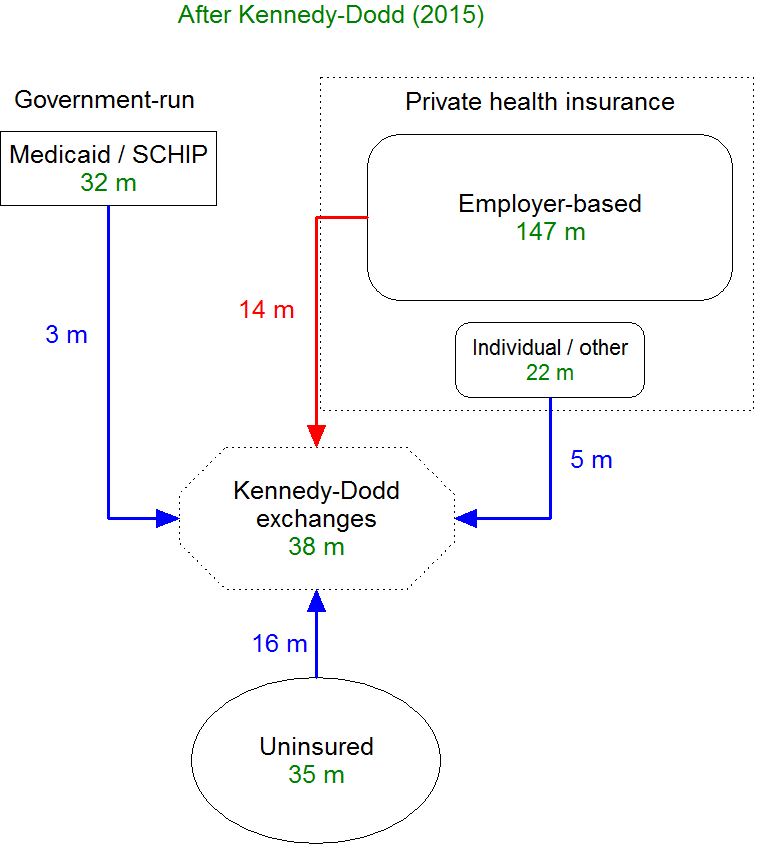
That 14 m number was a net figure. It was close, but not entirely correct. CBO Director Doug Elmendorf has posted a helpful follow-up on his blog which “unpacks” that red arrow into its component parts. Kudos to him for doing so. I am going to expand part of the above diagram using Dr. Elmendorf’s new information. These new lines below replace and correct the “14 M” red arrow and the “16 M” blue arrow from yesterday’s diagram above. I also have to shift from 2015, which I used yesterday, to 2017, which Dr. Elmendorf uses in his post. The two-year difference is trivial and does not change the underlying substantive point.
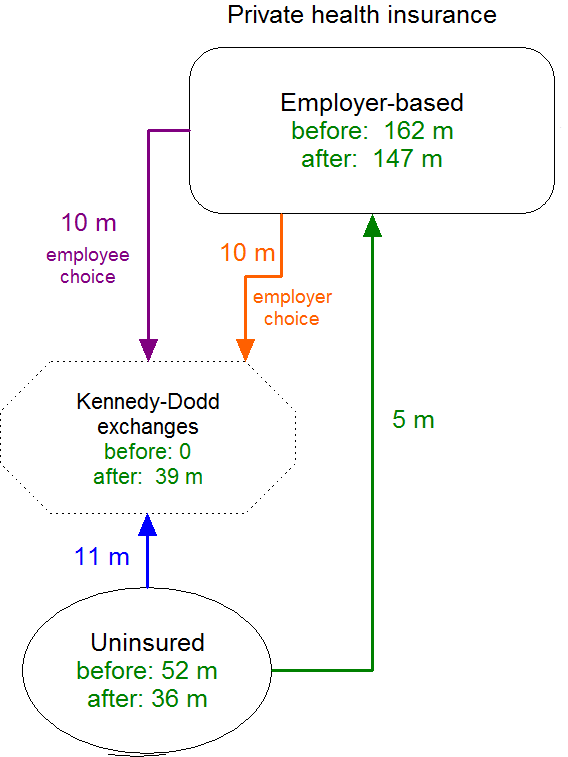
Director Elmendorf explains that, under the Kennedy-Dodd draft, 20 million people would leave employer-based insurance and instead use the new subsidies to buy insurance through an exchange.
10 million people, represented by the purple arrow I have labeled “employee choice,” would make this choice individually and voluntarily. Here’s Director Elmendorf:
Some individuals would have insurance coverage available from their employer, but would also have an option to obtain subsidized insurance from an exchange. That opportunity would exist for people whose incomes were sufficiently low—and the cost of employer-sponsored insurance sufficiently high—so that the insurance would be categorized as “unaffordable” under rules that would be set by the Secretary of Health and Human Services. … By CBO’s estimate, about 10 million people with this choice would opt to obtain insurance from exchanges rather than from their employer.
Another 10 million people, represented by the “employer choice” arrow, would lose their current employer-based insurance because their employer stops offering it. With that option vanishing, these people would then take advantage of the new subsidies and buy health insurance through an exchange. Here is more from Dr. Elmendorf:
The availability of subsidized coverage in the new insurance exchanges would be an attractive option for many lower-income workers. As a result, some employers would decide not to offer their employees health insurance coverage, opting instead to provide other forms of compensation. CBO estimates that about 10 million individuals who would be covered through an employer’s plan under current law would not have access to that coverage under the draft legislation because some employers would choose not to offer it.
Finally, yesterday I got the blue arrow from “Uninsured” to “Exchanges” wrong. I think I have it right now. 11 million people who were previously uninsured would now buy health insurance through an exchange (blue arrow). Another 5 million people who were previously uninsured would be newly covered by employer-based coverage (green arrow). Here’s Dr. Elmendorf one more time:
Finally, approximately 5 million more individuals would obtain employer-based coverage under the proposal (compared with the number under current law) either because they worked for a firm that newly began to offer coverage as a result of the legislation or because they decided to enroll in an insurance plan that the employer would offer under current law but which they would not select in the absence of the legislation. (Some workers would value an employer’s offer of insurance and be more willing to sign up for it because of the legislation’s requirement for individuals to have insurance; some employers would begin to offer insurance to accommodate employees’ desires and to take advantage of the subsidies that would be provided for some small businesses.)
The net effect of the blue and green arrows is still a decline in the number of uninsured by 16 m, but now it’s split into two parts. And the net decline in employer-based coverage is still the 14 million from yesterday, but that’s the result of (10 purple + 10 orange – 5 green = 15 red), where the 15 vs. 14 is from shifting from 2015 to 2017.
Losing employer-based coverage
While I am flagging it as substantively significant, it may surprise you that I am not going to criticize the Kennedy-Dodd bill for the harm done to these 10 million people who would lose their employer-based coverage through “employer choice.” This is a painful but unavoidable consequence of (partially) leveling the financial playing field between employer-based and individually purchased health insurance.
I strongly oppose the Kennedy-Dodd draft for reasons that I have previously described. But leveling this playing field is a good thing. Rather than creating a new spending program, I would completely level the playing field by eliminating the tax exclusion and creating a new tax preference for health insurance that was independent of how you bought it. When President Bush proposed such a policy in 2007, we faced the same effect that I describe here for Kennedy-Dodd. Some people are hurt because they would lose something they value and now have. If you design your plan right, far more people are better off, and you have to decide whether the tradeoff is worth it.
So while I am tempted to attack Kennedy-Dodd for this reason, my desired reform suffers the same downside. It is an unfortunate but unavoidable consequence of moving away from a system so heavily biased toward employer-based insurance. There are plenty of other reasons for me to oppose Kennedy-Dodd.
Team Obama’s political and legislative mistake
At the same time, this exposes a devastating tactical error by the President’s team. They put their boss out there saying:
If you like your health care plan, you will be able to keep your health care plan. Period. No one will take it away. No matter what.
Under the Kennedy-Dodd bill, that is not true for 10 million people. And the same will be true for any other bill that levels the playing field between employer-based and individually-purchased health insurance, which means any bill that offers subsidies to buy insurance outside of your job. You cannot avoid this problem. The mistake is not the unavoidable policy consequence. The mistake was making a Presidential promise that cannot be kept.
The Administration and its Congressional allies can mitigate but not eliminate the 10 million number. They can reinstate the employer mandate that Kennedy left out of the draft he gave to CBO, and I assume they will do so. By raising the costs on employers of dropping coverage, the 10 million number will go down. But to get that 10 million down a lot, they would have to make the financial penalty on employers for dropping coverage exceedingly high, and they would have to be explicit in their legislative language for a skeptical CBO to give them credit for it. The higher that penalty, the fiercer the opposition from employers. And no matter how high they raise that employer penalty, I expect CBO still would not take the 10 million figure down to zero. The Administration and its allies have boxed themselves into a corner.
The President made and repeated a sweeping promise, that no one would lose the health insurance and doctor they have now. This is smart politics and good legislative strategy as long as it doesn’t backfire. CBO is now on record that the Kennedy-Dodd draft does not fulfill the President’s promise. That’s an immediate problem for Kennedy and Dodd, and a near-term problem for the Administration, which now has to figure out whether they support an excruciating employer mandate to get the 10 million number down, and how they’re going to mitigate this problem for other bills that will have the same ugly feature. Even if they do, I expect that any solution will still violate the pledge for millions of people, although fewer than 10 million.
Had the President not made this statement, the Administration would have a policy problem with an obvious solution: get the number down through the employer mandate, and argue that those who are hurt are far outnumbered by those who are helped. Instead, they now have this policy problem, combined with a “Presidential promise” problem.
The President’s advisors never should have let him make this promise that he cannot keep.
(photo credit: whitehouse.gov)
Related Posts
(best matches are listed first)- Debating the President’s Portsmouth pitch (part 1)
- Fishy statements about health care reform
- New health insurance mandates would increase premiums
- The House-passed bill’s effects on health insurance coverage
- Senator Conrad’s co-op health insurance proposal
- CBO scores the Kennedy-Dodd bill
- Why you can’t do just the health insurance reforms
- Ten more things about the official Kennedy-Dodd health care bill


“One of the biggest problems with the U.S. system is our third party payment system where patients are oblivious to the actual costs of anything.”
True. And the insurers have been equally oblivious as they have been able to simply pass the costs onto to the policy holders.
And the insurers have had their chance to fix things. And they have refused. It’s time to bring in a competing plan.
“Combine that with entrepreneurial doctors who have every incentive to order more test and procedures with limited benefits and you have a pretty inefficient system.”
True. And I might add prescribing a drug that is 1% more effective yet 200% more costly.
So what do you think we should do? Do you favor some sort of a public plan?
“WASHINGTON, April 29 — Federal investigators have found that a handful of companies account for a growing share of the health insurance policies sold to small businesses in most states, leaving consumers with fewer options and higher costs.”
I appreciate the article but I don’t agree with the author’s conclusion. Manage Care profits are declining rather than increasing which is the opposite of what we would see with less competition.
“Georgetown University health economist Jean Mitchell said she sees one main reason behind any health care cost increase: overutilization. Mitchell, who was not involved with the survey, said health care costs have been rising faster than inflation because the payment system rewards care providers for doing more.
“Until we fix that, we’re never going to be able to rein in health care costs,” she said.”
http://www.forbes.com/feeds/ap/2009/06/18/ap6558954.html
There is not a great deal of disagreement among health care economists on the issue of overutilization. It is the primary driver of health care cost increases. Lack of competition among managed care companies is a political argument not an economic one.
kingstu,
Overutilization is certainly a problem. So why haven’t the insurers done anything about it? The answer is their is no incentive for them to do so. They can and have simply passed the costs onto policy holders. And yes, the doctors and hospitals are co conspirators.
The health care industry has stole from us long enough. They’ve blown their chance. In every other country in the world the government has stepped in and in every other country in the world their health care costs are 1/2 of ours. For the same level of care.
I’d like to hear your response to my questions in my previous post.
“So what do you think we should do? Do you favor some sort of a public plan?”
I only favor public financing for people who are poor. There is no reason for another entitlement for families making more than $75,000 per year.
1. Separate health care from employment by including health care as a taxable part of compensation.
2. Improve transparency in pricing and include treatment cost benefit data (this may have to be done by government)
3. Mandate catastrophic/emergency room coverage (emergency rooms must provide care so they should be reimbursed for it)
4. Tort reform
5. HSAs combined with high deductible insurance
At a certain point, we need to be mature about the R word, rationing. Either we “self ration” or a government agency rations for us. I prefer self rationing using my own money to pay for my own health care (up to about 10% of income per year then insurance pays the rest).
“Overutilization is certainly a problem. So why haven’t the insurers done anything about it? The answer is their is no incentive for them to do so. They can and have simply passed the costs onto policy holders. And yes, the doctors and hospitals are co conspirators.”
This is a good post and you are right on point. Then again, this is an argument that insurers should be denying even more procedures than they already do (which I agree with). IMO, insurance companies don’t deny more procedures because they can simply pass these costs along to their policy holders in the form of higher premiums. Since employees usually bear only a small portion of the increase they don’t demand tighter controls over treatments.
Arnold Kling does the best job of outlining the problem…
“What we want is unlimited access to medical procedures without having to pay for them. What we get is extravagant use of medical procedures with high costs and low benefits. This is unsustainable and it will stop.”
http://econlog.econlib.org/archives/2009/04/debating_health.html
“I only favor public financing for people who are poor. There is no reason for another entitlement for families making more than $75,000 per year.”
I don’t see it as an entitlement. I would gladly enroll in the public plan and would gladly pay for it. Agree that the poor need help. Especially the children of the poor. I believe all children should be covered. And believe me I live in a fairly well to do area and several of my daughters friends are not covered. And they have been at my house with health issues and refused to go to the doc because of such.
1. Separate health care from employment by including health care as a taxable part of compensation.
100% agree.
2. Improve transparency in pricing and include treatment cost benefit data (this may have to be done by government)
100% agree. This is my idea of a key role of a public plan. That and making sure everyone has equal access to basic services. (not losing your house because of cancer)
3. Mandate catastrophic/emergency room coverage (emergency rooms must provide care so they should be reimbursed for it)
Agree. Again, I believe the public plan would be more efficient.
4. Tort reform
Don’t care. It’s only about 1% of health care expenditures. I’d rather leave it only but would be willing to compromise.
5. HSAs combined with high deductible insurance
I have no problem with this but don’t see it helping much.
And I might add I strongly favor co pays for everything.
“At a certain point, we need to be mature about the R word, rationing. Either we “self ration” or a government agency rations for us. I prefer self rationing using my own money to pay for my own health care (up to about 10% of income per year then insurance pays the rest).”
The health insurance industry has been rationing for as long as I can remember. And they are profiting from it.
And I’ll say it again. the rest of the world (industrialized only), delivers the same quality of care as the U.S. for half the cost.
It long past time that we borrowed some of their ideas.
Thanks for your response and we are not really very far apart. And please take a look at Taiwan’s system. I think you’ll find it interesting.http://content.healthaffairs.org/cgi/content/full/22/3/77
And here is a short summary of Canada, France, Germany, U.K., and the V.A. worth reading.
http://www.prospect.org/cs/articles?article=the_health_of_nations
Taiwan link again. Something didn’t look right.
http://content.healthaffairs.org/cgi/content/full/22/3/77
“I don’t see it as an entitlement. I would gladly enroll in the public plan and would gladly pay for it.”
IMO, it would become an entitlement much like Social Security and Medicare and become subsidized through general tax revenues. If it is simply a voluntary income tax and the playing field is level with private plans…I would be indifferent to the public option. Then again, if the playing field were level, I don’t see any benefit to the public plan.
There is a pretty big difference between reimbursement and cost. If the public plan becomes a monopsony and sets the price, we will likely see greater doctor shortages especially among primary care physicians. It won’t do you much good to have a public insurance plan if no doctor will accept the lower payments.
“I don’t see any benefit to the public plan.”
We pretty far apart on that one. I see the public plan as critical. So let’s make sure we get a level playing field
Let’s be honest, Medicare works pretty well and is far more cost efficient.
“we will likely see greater doctor shortages especially among primary care physicians”
We’re already there. Absolutely we need more docs. Let’s start educating more of them.
Interesting is my 50 year old just quit her primary care practice just in the last 2 months. . She earned $75,000 annual and her biggest gripe was the insurance companies were running her office. She was one of five docs that had a staff of 17 to deal with the insurance companies.
kingstu,
Thanks for the debate.
I’ve gotta run but one last closing thought.
Your position seems somewhat contradictory. You favor Singapore’s system that relies heavily on a public plan, though not for everything.
And yet you are against a public plan for us.
“Let’s be honest, Medicare works pretty well and is far more cost efficient.”
It depends on the meaning of “works.”
Medicare:
1. Costs about $413BN per year
2. Has a $74T unfunded liability
3. Pays less than the cost to provide the service
FY09 Budget
http://aging.senate.gov/crs/medicare4.pdf
Unfunded Liability
http://online.wsj.com/article/SB120373015283387491.html
“Your position seems somewhat contradictory. You favor Singapore’s system that relies heavily on a public plan, though not for everything.
And yet you are against a public plan for us.”
I would support any plan (public or private) where the patient pays a significant portion out of their own pocket at the point of service. Also, I have an inherent distrust of government from studying public choice theory.
“Your position seems somewhat contradictory. You favor Singapore’s system that relies heavily on a public plan, though not for everything.
And yet you are against a public plan for us.”
I would support any plan (public or private) where the patient pays a significant portion out of their own pocket at the point of service. Also, I have an inherent distrust of government from studying capture theory.
I would support a public option modeled on this…
“The Safeway plan has two main parts that work in tandem. The first involves giving employees a financial stake in the system. Safeway demolished the traditional PPOs and HMOs that encourage consumers to be cavalier about costs. The company today fully pays for an array of primary and preventive visits and tests. But beyond that, employees have skin in the game. The company deposits $1,000 each year into a “health reimbursement account,” which workers can use to pay for care. The next $1,000 in expenses is the employee’s responsibility. After that, employees pay 20% of costs up to a $4,000 maximum.”
http://online.wsj.com/article_email/SB124536722522229323-lMyQjAxMDI5NDE1OTMxNjk3Wj.html
My current plan is very similar:
$2,500 – deductible
$25 – cost per paycheck
$1,800 – flex spending balance
10% – coinsurance after $2,500 deductible
$8,000 – annual out of pocket maximum
” If you like your health care plan, you will be able to keep your health care plan. Period. No one will take it away. No matter what.”
Yeah, sure. He doesn’t want to run banks or auto companies either. He is a damned liar. He’ll tax any private insurance out of existence.
drjohn
Commented on June 19, 2009 at 6:34 pm |
” If you like your health care plan, you will be able to keep your health care plan. Period. No one will take it away. No matter what.”
Yeah, sure. He doesn’t want to run banks or auto companies either. He is a damned liar.”
And you sir, are < redacted by kbh >
Not only is your comment inappropriate it has nothing to do with the subject at hand.
Go jump in the lake.
You are forgetting one key fact.
What about Insurance companies that collapse, go bankrupt, or just get out of healthcare……..which is sure to happen. If your insurance company is not able to maintain profitability after the regulations……….then they may chose to pull out of the insurance markets.
This will happen more and more as fewer people are enrolling in private plans…choosing the free stuff instead.
If your Insurance Company pulls out of the Health Insurance market, and will not offer your company coverage anymore…………then you will not be able to keep your coverage.
“Also, I have an inherent distrust of government from studying capture theory.”
And I have a well founded distrust of business having been in it for 25 years. I’m not a big fan of government, they are not to be trusted. Business is to be trusted less.
And with the government we get a chance to vote the bums out. No such luck with business. As a matter of fact, the more business can gouge and over charge and deny claims and deny coverage, the better the shareholders like them.
kingstu
Commented on June 19, 2009 at 6:23 pm |
“I would support a public option modeled on this…”
I’ve got no problem with the plan you support.
As long as it is a public insurance plan. It is time the private insurers get some competition. The profit incentive from denying claims and denying coverage needs to be stopped.