sources-of-american-consumed-oil1.png

Sloppy energy language: dependence on foreign oil

This is good language from the President in bold:

America’s dependence on oil is one of the most serious threats that our nation has faced.

This is not:

They’ll be jobs building the wind turbines and solar panels and fuel-efficient cars that will lower our dependence on foreign oil …

Nor is this:

And just last week I visited the Electric Vehicle Technical Center in Pomona, California, which is testing batteries to power a new generation of plug-in hybrids that will help end our dependence on foreign oil.

Is the U.S. dependent particularly on foreign oil, or just to oil? Is there anything we can do to break our “addiction to” or “dependence on” foreign oil?

In the Bush White House, policy staff worked hard over several years to excise the phrases “dependence on foreign oil” and “addiction to foreign oil” from the President’s prepared remarks. I hope the Obama team goes through the same effort.Sloppy language on this point creates expectations that can never be met by policy.

In 2008 the U.S. consumed an average of 14.7 million barrels of crude oil per day. U.S. suppliers produced just under 5 million barrels per day (bpd), meaning we imported 9.8 million bpd from the rest of the world.

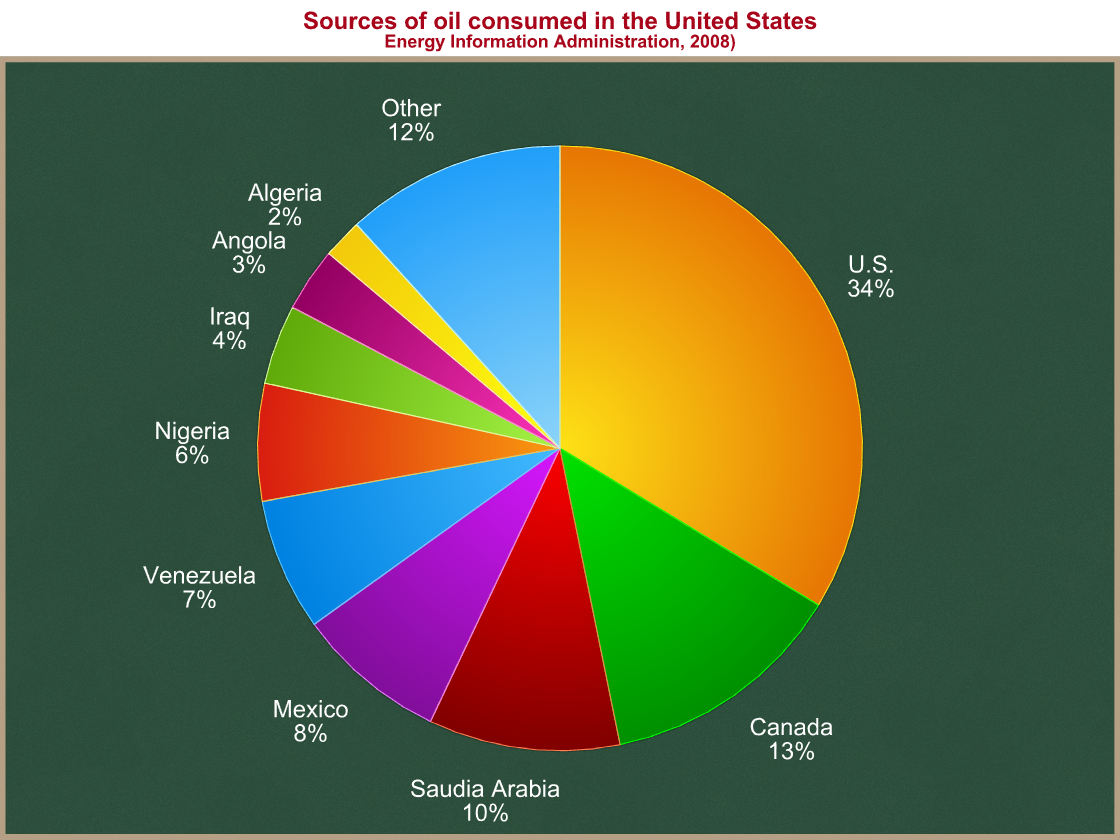
You might be surprised to know that two of our top three foreign suppliers are Canada and Mexico. Here is where U.S.-consumed oil came from in 2008 (data comes from the Energy Information Administration here and here):

sources_of_American_consumed_oil

Well, that’s easy, you might say. Domestic production is fine, and Canada and Mexico are friendly and stable neighbors. How much oil do we get from unstable or unfriendly parts of the world? Maybe 30-40%? So if we reduce our oil demand by 40%, then we don’t need to import oil from the Middle East, or Venezuela or Nigeria. Problem solved. We will have eliminated our dependence on foreign oil, or at least on foreign oil from unstable or unfriendly parts of the world. (I will ignore for the moment whether it is feasible to reduce domestic oil demand by 40%.)

This is the flawed logic that supports the phrase ”dependence on foreign oil.” It suggests that we can control the source of American oil. We cannot, and even if we could, it would not matter.

Two things matter to U.S. citizens when we think about imported oil:

  1. Large portions of the global oil supply are vulnerable to shocks. These shocks, hurt all consumers of oil, no matter where they occur.
  2. A significant share of U.S. income goes to people we do not like (e.g., President Chavez’ government) to pay for the oil they supply us. They use these profits to do things we do not like.

Imagine a huge reservoir, being filled by a handful of large rivers and a whole bunch of tiny streams. Several of the large rivers are controlled by governments (labeled “Saudi Arabia,” “Iraq,” “Iran,” “Nigeria,” and “Venezuela”) and are subject to being instantaneously shut off (or dramatically reduced) at any point in time. Everybody dips their cups into the reservoir to drink.If any one of those rivers shuts off or diminishes, there is suddenly less water going into the reservoir, and everybody who drinks from it is hurt (the level in the reservoir drops and the price of water spikes upward).

In a global oil market, consumers of oil buy it from wherever it is least expensive. The relative sizes of the above wedges are based on the relative costs of shipping oil to the United States.

Imagine a world in which the U.S. produced 15 million bpd domestically, more than meeting our domestic needs, and that we imported no oil from other countries. Now imagine a big supply shock outside the U.S. (a terrorist attack in the Middle East, Nigeria rebels, the Iranian or Venezuelan government shuts off supply just because they can). Those nations that import from the affected country would lose their supply source. They would bid up the price of oil worldwide, including in the U.S. American consumers and firms would have to pay higher prices even though the supply shock occurred in a country from which we import no oil. We are still vulnerable to supply shocks in unfriendly or unstable nations whether or not we import directly from them. We are vulnerable to shocks in the supply of oil, wherever it occurs.

From a rhetorical perspective, we are “addicted to oil” or “dependent on oil.” We are not particularly dependent on foreign oil more than domestic oil. And since it is cheapest to produce oil in the Middle East, to the extent we use oil at all, some of it will always be imported. In terms of the graph above, if a new battery technology were to reduce the amount of oil used in the U.S. by half, and therefore reduce the total area of that pie chart by half, you would roughly expect the pie to shrink [Update: see correction below], rather than to lose particular slices. We would still be sending American cash to oil suppliers from states with unfriendly leaders (like Venezuela), just less of it. Becoming more efficient in our usage of oil will help achieve this goal, but will not result in a shift away from any particular supplier nation.

There is a counterargument, but it’s a stretch.” You could argue that since foreign oil is a subset of oil, if our goal is to reduce our dependence on oil, it is not inaccurate to highlight a subset of that goal. “Dependence on foreign oil” is not incorrect, a speechwriter or communicator might argue, just misleading.

This misleading language, used by the President and Vice President and Members of Congress on both sides of the aisle, creates the impression that this particular problem of foreign oil can be solved. We can reduce our demand for oil in several ways, but we cannot solve the rhetorically attractive but misleading problem if it is defined as “dependence on foreign oil.”

Update: A commenter correctly points out that you would not expect the pie to shrink proportionately, but instead for the highest marginal cost producer of oil to drop out first. I believe that is correct as a global matter. It’s harder to tell exactly how dropping the highest marginal cost producer would affect any particular country’s sources, as things would shift around. But my earlier statement about “roughly expecting the pie to shrink” was an incorrect oversimplification. The point that we could not choose which slices to drop still stands.

9 Responses to “Sloppy energy language: dependence on foreign oil”

  1. Keith, Idea for a future set of blogs:

    Is there any reasonable way to significantly reduce our dependence on oil? If yes, in what time frame? Should we be trying to reduce our dependence on oil? Or reduce our consumption of oil, or slow the growth in consumption of oil? Why don’t we just let the market forces decide what energy sources to use?

    Thanks, John

  2. I, too, cringe whenever I see someone talking about the need to reduce our dependence on “foreign oil”. It is indeed misleading, a point I made here http://www.capitalgainsandgames.com/blog/pete-davis/392/gasoline-prices#comment-633 among other places.

    As just a note, one can make an argument on the basis of improving our balance of trade, but usually that is not the basis for the argument and associated rhetoric. Rather, it is (primarily) gas and oil prices, as well as (secondarily) oil money ending up in the hands of the bad guys.

  3. Dear Keith Hennessey: I have NO IDEA what YOUR POINT IS ! ! I also, Went to The Same University and The Same law School. as Did Trent Lott ! ! I grew up in the Same Part of The State of Miss.

    I Voted for George W. Bush Twice, and i am STILL DISSAPOINTED in Both Trent and BUSH ! !

    I Owned some Furniture Factories in Miss. and BELIEVE ME, NONE of YOU Did anything to KEEP the Furniture or the Fabric Industry HERE in the USA ! !
    Like it or NOT OIL is VITALLY IMPORTANT TO THIS COUNTRY and ESPECIALLY to The WORKING CLASS ! !

    Since I Sold out the Furniture Factories and Tried to Import Furniture from China ( ANOTHER MISTAKE our Country has MADE). I got Interested in Alternative Energy, Especially Wind and Solar.

    Let ME Make a Simple Comment. NEITHER WORK AS WELL AS OIL,,NATURAL GAS OR COAL. ALL of the latter Three are Avaliable and Cheaper that an UNKNOWN, UNPROVED Source of “ALTERNATIVE,, RENEWABLE ENERGY” – - (Thank YOU AL GORE)

    And The Politicians and Beauracrats 9Such as YOURSELF) have Sold Out to the “GREENIES’ TREE HUGERS “WOLF SAVERS” because of VOTE FREIGHT.

    NONE of YOU GUYS have any “HUEVOS” ! ! NOR do YOU have STRONG ENOUGH SPINES OR LEGS to STAND UP FOR AMERICA THE GREATEST (USED TO BE) COUNTRY IN THE WORLD ! !

    “DRILL HERE! ! DRILL NOW ! ! Work on Some Form of Clean Coal, FIGHT UNIONS and GET AMERICAN WORKERS BACK ON THE JOB ! !

  4. Anne Harrison 27 April 2009 at 8:06 pm

    Slowly increase the tax on oil/gasoline and you will see our use of it plummet. However, I seriously doubt if any politician has the political will to do so. Increasing the cost is the most efficient method and leaves the decisions on cutting back up to citizens not crazy mixed up schemes of Washington.

  5. Anne,

    I agree. A simple carbon tax would be better than “cap-and-trade”, and my guess is that the only reason the latter is more politically feasible is because it is more of a hidden tax and thus not politically costly.

  6. Hi Kieth,
    I think that your pie will not shrink proportionally but starting with the highest marginal cost producer of oil. It doesn’t take much imagination to see that we might be left with a smaller pie produced mostly by people we don’t like. Do you think that a sustained minimum price on oil, say $50-$60 a barrel would provide the continued incentives required for investment into energy alternatives? I think that the prices of the last couple of years would make that seem a reasonable price to the consumer, while automatically reducing if prices go above that level.

  7. Thanks, Keith, for pointing this out. These are silly political catch phrases that both sides use to suck people into buying their agenda. I could see someone making the argument that we don’t want to be beholden to a hostile country for an important natural resource because it could influence our defense policy. On the other hand, since most of our imported oil comes from Canada (our best trading partner), threatening to cut off trade with them on oil or any other commodity is irresponsible foreign policy.

    Either way, fact still remains that on an economic level a shock in one place is a shock for every consumer. Better to diversify our energy portfolio across the board.

    John – I like your blog ideas…spoken like a true libertarian. :) Although one could argue that by subsidizing and supporting the American auto industry (and in effect, their unwillingness to implement any sort of innovative technology), the government already pushed us toward dependence on oil in the first place. So the question becomes, are they pushing too much toward alternative energy or are they correcting the mess they made in the first place?

  8. The point must also be made that nearly no oil – foreign or domestic – goes into generating electricity in the US, while most of the alternative sources of energy supply only electicity. Oil is the primary source of energy for transportation, while nearly no electricity is used directly for that purposes (just some trains and trams in Philadelphia that I know of). So, before these alternative sources can have the slightest impact on oil imports, there must be a significant technology shift from liquid fuels to electricity in cars and trucks. Manipulating prices may have some influence on decisions people make, but if a technology is tossed into the marketplace before it has matured sufficiently, the product is more likely to be still-born rather than viable. The idea to push may be that rushing the process, even with good intentions, can be injurious…

  9. Slowing down American oil dependence would be very helpful in weakening some governments, particularly with Venezuela. Drop demand for oil sufficiently, and suddenly nobody wants to invest in either PSVDA (the Venezuelan oil company) or put money up for developing the tougher Orinoco fields, which means that not only would there be less money coming in from the oil sales, but the supply would ultimately constrict considerably for them. That would help weaken the Resource Rentier State model, which I consider to be a very good thing.

    Slowly increase the tax on oil/gasoline and you will see our use of it plummet. However, I seriously doubt if any politician has the political will to do so. Increasing the cost is the most efficient method and leaves the decisions on cutting back up to citizens not crazy mixed up schemes of Washington.

    That’s definitely the case, not to mention that it would use an existing system of tax collection and eliminate the need for those idiotic CAFE standards. The vast majority of American oil consumption goes into the transportation sector, so this would be a strong incentive to switch over to hybrid cars, natural-gas driven cars (which have less CO2 emissions, and we have a more “secure” natural gas supply, so to speak), and greater use of public transportation.

Follow

Get every new post delivered to your Inbox.

Join 5,643 other followers